Although Carlos Frederico Bremer is the key strategist with the background and intellectual capacity to develop a business case determining Brain4Care’s current value—especially given his role in its creation and his intimate knowledge of the underlying realities—a study of this nature requires validation by someone with unparalleled, top-tier credentials.
It need not be him specifically, but rather someone with a profile like that of Professor Ademir Peteneate—an expert who not only masters statistics but has also implemented operational improvements at both the Faculty of Medical Sciences and the Unicamp Hospital, and whose track record demonstrates a detailed explanation of the assumptions used to calculate Brain4Care’s value.
Methodology
Brain4Care’s technological breakthrough is already widely recognized, not only in scientific literature but also through its adoption by leading institutions such as Johns Hopkins.
A methodological breakthrough for quality improvement was introduced by William Edwards Deming (1900–1993)—an American statistician, professor, and consultant widely recognized as the “father of modern quality” and of data-driven management. He is renowned for leading Japan’s industrial revolution following World War II, transforming products once labeled as “low quality” into global benchmarks of excellence and technological innovation.
His key contributions included:
- The PDCA Cycle: He popularized a continuous improvement method comprising four essential steps: Plan, Do, Check, and Act.
- The 14 Principles of Quality: He developed guidelines to transform business management, focusing on eliminating fear in the corporate environment, breaking down departmental barriers, and doing away with arbitrary numerical targets.
- The System of Profound Knowledge: A management philosophy grounded in four interconnected pillars: a systems view of the organization, an understanding of statistical variation, the theory of knowledge, and the psychology of human behavior.
IHI adoption of Deming’s methodology
The Institute for Healthcare Improvement (IHI) is a global non-profit organization leading the worldwide movement for patient safety and continuous quality improvement in healthcare. Founded in 1991 by Don Berwick and a group of visionaries, the IHI sought to address a critical problem: the high rate of preventable medical errors, resource waste, and dangerous variability in patient care.
The IHI’s major innovation was adapting the science of industrial improvement directly to hospital and clinical settings, utilizing theoretical foundations established by W. Edwards Deming.
The IHI’s Model for Improvement and Deming’s Legacy
The IHI consolidated its methodology into the renowned Model for Improvement, which serves as the backbone of its interventions worldwide. This framework integrates Deming’s statistical and human principles into a practical approach to healthcare:
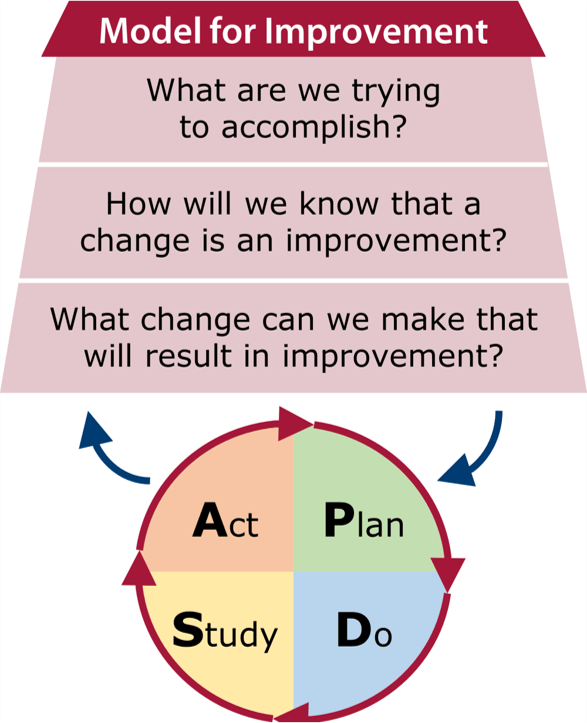
Model for improvement in detail
What specific metrics should be used to track progress in health initiatives? How can teams ensure that the changes they make are evidence-based? What are some examples of practical changes that have successfully led to improvement in healthcare settings?
How this connects with Brain4care:
Why use the Model for Improvement Methodology to ask for NCS/CONITEC reimbursement catalog
For two basic reasons:
First, it had not been taken into account that, as much as a technological breakthrough — and it was flawlessly defended —including the strategy of emphasizing it particularly for healthcare sectors responsible for recognizing and incorporating it into their fields of activity, the issue of how it would be paid for and by whom was not addressed. This resulted in there being no way to obtain compensation for using the braincare method through reimbursement, because the definition and the reason why health insurance plans should pay for it had not yet been established.
Second, this definition must be based on standardized criteria and methodology used by both parties’ systems, so that this inclusion becomes acceptable. The choice of method indicated by the Institute for Healthcare Improvement is the most appropriate to do this and was used in this valuation of Brain4Care, and here it is explained why:
The IHI Triple Aim Framework
The Triple Aim is a foundational framework developed by the Institute for Healthcare Improvement (IHI) to help health systems optimize performance. It asserts that any healthcare initiative must balance three critical dimensions simultaneously to achieve true systemic improvement: [1, 2]
Healthcare Triple Aim: How Nursa Helps Hospitals & Clinicians
A Guide to Measuring the Triple Aim: National Health Care for the Homeless Council
Medical Respite Care Programs & the IHI Triple Aim Framework
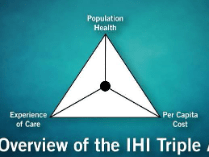
An Overview of the IHI Triple Aim – YouTube
Improving the Patient Experience: Enhancing the overall quality, safety, patient satisfaction, and accessibility of care. [1, 2, 3]
- Improving Population Health: Bettering health outcomes for an entire geographic or demographic community (e.g., managing chronic diseases). [1]
- Reducing Per Capita Cost: Eliminating medical waste and reducing the overall financial burden of healthcare on families and institutions. [1]
(Note: In recent years, this has evolved into the Quadruple Aim, adding a fourth pillar: improving the work-life of healthcare providers to prevent clinical burnout).
Practical Healthcare Example: A Hospital PDSA Cycle
Let’s look at a concrete healthcare scenario applying Deming’s PDSA Cycle (Plan-Do-Study-Act).
The Problem: An inpatient medical ward has an unacceptably high average discharge time of 4.5 hours after the physician signs the discharge order, leading to emergency room boarding bottlenecks.
 [Plan: Pick 1 doctor & 2 patients] ──> [Do: Test the new checkout checklist]
                ▲                                      │
                │                                      ▼
 [Act: Adapt the checklist for Ward B] <── [Study: Discharge took only 45 mins]
Cycle 1 (Small Scale Test)
- Plan: The team predicts that utilizing a dedicated “Discharge Checklist” completed by the nurse the night before discharge will cut wait times. They plan to test this with only 1 physician and 2 patients tomorrow morning.
- Do: The selected nurse and physician execute the plan. They use the checklist for those 2 specific patients, tracking the exact timeline.
- Study: The data reveals that the discharge for those 2 patients dropped from 4.5 hours to just 45 minutes. However, the pharmacy took longer than expected to deliver the take-home medications.
- Act: Based on the learning, the team decides to adapt the process. They will run Cycle 2 next week, expanding to the entire daytime nursing shift and looping the hospital pharmacist into the planning stage.
Run Charts: Visualizing Improvement over Time
A Run Chart is a graph of data ordered over time. It is one of the most powerful tools the IHI borrowed from Deming’s statistical toolset because it distinguishes a real improvement from random daily fluctuation.
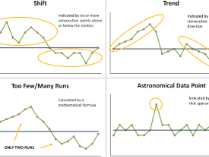
Run Charts – Improvement | the Complete Medic
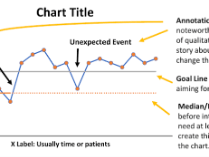
How to Select and Use Run and Control Charts: Learning Network
Key Structural Elements:
- Y-Axis: The quality measure being tracked (e.g., Discharge Time in Minutes).
- X-Axis: A time sequence (e.g., Days, Weeks, or successive Patients).
- The Median Line: A horizontal line calculated from baseline data to serve as the reference point.
- Annotations: Specific text markers added directly to the chart indicating exactly where a PDSA change was introduced. This explicitly ties your interventions directly to changes in the data trend line.
How to Identify Real Improvement (Non-Random Variation):
When monitoring a Run Chart, healthcare managers use specific mathematical rules to prove a change actually worked:
- The Shift: Six or more consecutive data points falling entirely above or entirely below the median line. If discharge times stay below the median for 6 straight days following a PDSA cycle, the process change is statistically validated as a true success.
- The Trend: Five or more consecutive data points consistently heading in a single direction (all climbing or all dropping).
The above examples of Run Chart dataset simulation using Python and explorations of how to handle clinical resistance when introducing these PDSA tools to medical staff are presented, detailing the why and how they connect to reimbursement plans and are entitled of

