
In Andrew Wyeth’s own words the main point of his work:
“…do justice to her extraordinary conquest of a life which most people would consider hopeless. If in some small way I have been able in paint to make the viewer sense that her world may be limited physically but by no means spiritually, then I have achieved what I set out tod do.”
Andrew Wyeth’s Christina’s World – Analysis Summary
Andrew Wyeth’s Christina’s World (1948) is a celebrated piece of American realism, depicting a young woman lying in a vast, open field with her gaze fixed on a distant farmhouse. This haunting and enigmatic painting invites diverse interpretations through its subtle details, stark composition, and underlying narrative.
Key Elements of the Analysis:
- Subject and Context:
- The figure in the painting is Christina Olson, a neighbor of Wyeth who suffered from a degenerative muscular condition that left her partially paralyzed.
- The painting captures her resilience and independence as she navigates her familiar environment despite physical limitations.
- Symbolism:
- The open field symbolizes isolation and vulnerability, while the farmhouse represents hope, determination, and perhaps unattainable goals.
- Christina’s pose—crawling yet looking forward—embodies strength and longing, highlighting the tension between human frailty and willpower.
- Visual Composition:
- Wyeth’s use of muted, earthy tones reflects a sense of nostalgia and stark realism.
- The placement of Christina in the foreground, surrounded by vast emptiness, emphasizes her smallness in contrast to the overwhelming world around her.
- Emotional Impact:
- The painting evokes empathy and introspection, drawing viewers into Christina’s perspective.
- Its ambiguous narrative leaves room for personal interpretation, allowing viewers to project their own emotions and stories onto the scene.
- Themes:
- Themes of perseverance, isolation, and the relationship between humans and their environment are central to the work.
- The interplay between limitation and aspiration speaks to universal human experiences.
- Cultural Significance:
- Christina’s World is often seen as an iconic portrayal of American rural life in the mid-20th century.
- It bridges realism and abstraction through its minimalist detail and evocative emotional resonance.
Wyeth’s painting continues to captivate audiences through its profound ability to communicate complex emotions and universal themes with simplicity and precision. Its timelessness lies in its capacity to inspire reflection and dialogue about the human condition.
My post will stress the human condition in terms of its ultimate reality faced with “To be or not to be”.
To be or not to be
Shakespeare’s soliloquy “To be or not to be” from Hamlet (Act 3, Scene 1) is one of the most famous passages in literature, offering profound insights into human existence, morality, and the struggles of the mind. Here’s a summary of its analysis:
Context:
- Hamlet, the Prince of Denmark, delivers this soliloquy as he wrestles with existential questions and moral dilemmas.
- He is contemplating the value of life versus the unknowns of death, prompted by his deep despair and the burdens of his circumstances, including the murder of his father and his quest for vengeance.
Key Themes:
- Existential Dilemma:
- The soliloquy begins with Hamlet questioning the worth of life itself: “To be or not to be, that is the question.”
- It reflects the universal human struggle with existence and the fear of the unknown that prevents decisive action.
- Suffering and Mortality:
- Hamlet considers whether enduring the pains of life (“the slings and arrows of outrageous fortune”) is preferable to facing the uncertainties of death (“the undiscovered country”).
- He describes life’s trials—oppression, scorn, heartbreak, and injustice—as burdens everyone endures.
- Fear of the Unknown:
- Death is likened to sleep, which might bring peace, but also potentially dreams (uncertainties or horrors of the afterlife): “What dreams may come.”
- This fear of what lies beyond life keeps people bound to their struggles, despite their misery.
- Paralysis of Action:
- The soliloquy addresses the human tendency to hesitate when faced with consequential decisions, driven by fear, doubt, and overthinking: “Thus conscience does make cowards of us all.”
- Philosophical Inquiry:
- Hamlet’s introspection represents a deeply philosophical meditation on life’s purpose, the nature of suffering, and the ethics of suicide.
Structure and Style:
- Language: The soliloquy uses metaphor and imagery (e.g., “sea of troubles”, “sleep of death”) to illustrate abstract ideas.
- Rhetorical Questions: Hamlet’s rhetorical questioning draws the audience into his inner conflict.
- Tone: The tone shifts from contemplative to anguished, mirroring Hamlet’s emotional turmoil.
Interpretations:
- Psychological Depth:
- The speech reflects Hamlet’s internal struggle and deep depression, embodying the human experience of uncertainty and fear.
- Philosophical Universality:
- It transcends Hamlet’s situation to address timeless questions about life’s meaning and the human condition.
- Moral Debate:
- It invites reflection on the morality of suicide and the implications of avoiding difficult choices.
Cultural Significance:
- The soliloquy’s enduring power lies in its universal appeal, resonating with anyone grappling with profound doubts or choices.
- It exemplifies Shakespeare’s genius in blending poetic beauty with profound existential inquiry.
In essence, “To be or not to be” is a masterful exploration of the human psyche, confronting the fears, doubts, and hopes that define human existence.
Human Condition as to its existence
I will strech the symbolism which I see in this video thinking that all of us, living beings, we share a pre condition before entering the sophistication and complications that Shakeaspeare and Wyeth so well knew how to put: you first have to be alive.
There are some interesting features of this porcupine family video that have to be observed:
Freud said that we are like porcupines that have to hug one another.
Sigmund Freud referenced Arthur Schopenhauer’s porcupine metaphor in his 1921 essay “Group Psychology and the Analysis of the Ego”. Freud used this parable to illustrate the complexities of human relationships, particularly the tension between intimacy and self-protection.
Freud’s Use of the Porcupine Metaphor:
- In “Group Psychology and the Analysis of the Ego”, Freud discusses the challenges individuals face in forming close bonds while maintaining personal boundaries.
- He quotes Schopenhauer’s parable of the porcupines to highlight the psychological discomfort inherent in relationships:
- Humans, like porcupines, seek closeness for warmth (emotional connection and support).
- However, too much closeness risks pain (conflicts, vulnerabilities, or the fear of losing individuality).
- This leads to a dynamic of approaching and withdrawing—a balance that defines human social interactions.
Relevance to Freud’s Theories:
Freud connects the porcupine parable to:
- The Ambivalence of Love and Aggression:
- Relationships are characterized by both affection and hostility, reflecting Freud’s concept of ambivalence in human bonds.
- The Role of the Ego in Groups:
- In group dynamics, individuals negotiate the desire for connection with the fear of losing their personal identity or being hurt.
- Human Vulnerability:
- Freud uses this metaphor to emphasize that the pain of relationships is unavoidable, but so is the need for connection. Humans must navigate this tension to maintain social bonds.
This metaphor continues to resonate as a powerful illustration of the human condition, encapsulating our struggles with intimacy, individuality, and the need for connection in social life.
What an amazing display. The parents had such good coordination and discipline in their defensive positioning. And even the porcupettes knew where to be and were quick to stay in their positions. Unbelievable. Great job mom and dad.
What is not apparente, but is there, is all the aspects that Freud so brilliantly put on.
One amazing feature of the implications saw in this metaphor that animals, specially mammals, share with us human all these characteristics emotionally.
There is a tendency to discuss the human condition in sophisticated, complicated terms, with a context that often requires effort and even help, especially in literature. I will emphasize this more directly, under the skin, for the common person through the eyes of the depiction several artists left us with their paintings that have explored the theme.
Before that, I will sumarize the complicate discussion that normally is associated with the theme:
The theme of the human condition is a profound and expansive concept that examines the essence of human existence, exploring universal experiences, emotions, and dilemmas. It is a central theme in philosophy, literature, art, and psychology, focusing on what it means to be human.
Key Aspects of the Human Condition
- Mortality and Existence or act to exist:
- Humans grapple with the awareness of their mortality, prompting existential questions about life’s meaning and purpose.
- Themes of death, legacy, and the search for meaning are explored in works like Albert Camus’s The Stranger and Shakespeare’s Hamlet.
- Emotions and Relationships:
- Love, hate, joy, grief, hope, and despair are intrinsic to the human experience.
- Interpersonal relationships, including family, friendships, and romantic bonds, define much of human existence and the complexities of connection.
- Suffering and Resilience:
- Pain, adversity, and loss are universal, but so too is the resilience to overcome and find meaning in suffering (e.g., Viktor Frankl’s Man’s Search for Meaning).
- Freedom and Choice:
- Humans face the responsibility and burden of making choices, navigating moral dilemmas, and exercising free will.
- Existentialist thinkers like Jean-Paul Sartre emphasize the anxiety and liberation associated with human freedom.
- Identity and Self-Discovery:
- Questions of “Who am I?” and “What defines me?” are central to the human experience.
- Themes of identity are deeply explored in literature, such as Ralph Ellison’s Invisible Man and Franz Kafka’s The Metamorphosis.
- Connection to Nature:
- Humans’ relationship with the natural world reflects awe, dependency, and conflict.
- Works like Henry David Thoreau’s Walden explore the quest for simplicity and harmony with nature.
- The Search for Transcendence:
- Religion, spirituality, and the pursuit of something greater than oneself highlight humanity’s longing for transcendence.
- This is often portrayed in art, from Michelangelo’s Creation of Adam to the works of Rumi.
- Conflict and Struggle:
- Internal and external struggles—wars, societal oppression, personal guilt—are central to the human story.
- George Orwell’s 1984 and Arthur Miller’s The Crucible portray these conflicts powerfully.
The Human Condition in Philosophy
- Existentialists like Kierkegaard, Heidegger, and Sartre focus on the individual’s confrontation with existence, freedom, and authenticity.
- Humanists like Erich Fromm and Carl Rogers explore human potential, creativity, and the quest for fulfillment.
- Ancient philosophers, such as Aristotle and Confucius, addressed ethical living and the pursuit of happiness as defining aspects of humanity.
The Human Condition in Art and Culture
- Art: Paintings like Edward Hopper’s Nighthawks capture human isolation, while Auguste Rodin’s The Thinker epitomizes introspection. Christina’s world is one of the best examples.
- Literature: Works like Mary Shelley’s Frankenstein delve into the ethical and emotional complexities of human nature.
- Film: Movies like The Tree of Life and The Seventh Seal explore life’s big questions with visual and narrative depth.
Enduring Questions of the Human Condition
- What does it mean to live a meaningful life?
- How do humans navigate the tension between individuality and community?
- What role does suffering play in shaping human identity?
- Is there an inherent purpose to human existence?
The theme of the human condition is timeless because it reflects our shared humanity, inviting endless exploration and interpretation across cultures and disciplines.
“what do I do with what I have got”
The question “What do I do with what I have got?” is an essential aspect of the human condition, reflecting themes of agency, purpose, and self-realization. It speaks to how individuals navigate their unique circumstances—be they talents, limitations, or resources—and make choices that shape their lives and the lives of others.
Relevance to the Human Condition
This question encapsulates a key existential dilemma:
- Self-Awareness:
- Recognizing one’s strengths, weaknesses, and opportunities is the first step toward answering this question.
- Philosophers like Socrates emphasized self-knowledge as the foundation of meaningful action: “Know thyself.”
- Agency and Free Will:
- It addresses the capacity to take action within one’s circumstances, however constrained they may be.
- Existentialists, like Jean-Paul Sartre, argue that humans are condemned to freedom: we must take responsibility for our actions, even when the choices are difficult or limited.
- Purpose and Fulfillment:
- This question directly engages with the idea of living purposefully, maximizing potential, and contributing meaningfully to society.
- It aligns with Viktor Frankl’s belief that the search for meaning is a fundamental human drive, even in challenging circumstances.
- Moral and Ethical Responsibility:
- It also raises ethical concerns: How should one use their gifts? For personal gain, collective good, or something transcendent?
Applications Across Human Experience
- Literature:
- In To Kill a Mockingbird by Harper Lee, Atticus Finch uses his intelligence and legal expertise to fight for justice, even against systemic prejudice.
- In Shakespeare’s Macbeth, Macbeth chooses to misuse his ambition and power, highlighting the darker side of this question.
- Philosophy:
- Aristotle’s concept of eudaimonia (flourishing) suggests that humans should aim to live virtuously, maximizing their unique potential.
- Psychology:
- Abraham Maslow’s hierarchy of needs suggests that self-actualization—using one’s abilities to their fullest—is the pinnacle of human achievement.
- Real Life:
- Individuals like Helen Keller, who overcame immense challenges to lead impactful lives, exemplify how people answer this question with resilience and creativity.
- Christina’ world and her attitute to her physical limitations
Modern Interpretations
In today’s context, “What do I do with what I have got?” often ties into:
- Personal Growth: How can I develop my skills, overcome my limitations, and make the most of opportunities?
- Social Contribution: How can I use my resources to benefit others or address societal challenges?
- Sustainability: How can humanity collectively use its resources to preserve the planet and ensure a livable future?
Philosophical and Practical Reflections
- The question demands a balance between humility (acknowledging limits) and ambition (striving for greatness).
- It is not just about what we can do, but also about what we should do, incorporating moral, spiritual, and existential dimensions.
“What do I do with what I have got?” lies at the heart of being human: it bridges our inner potential with our outer reality and invites us to act meaningfully within the finite context of our lives.
Where do I find examples of those themes in painting?
The themes of the human condition, including questions like “What do I do with what I have got?”, are richly explored in the visual arts. Many iconic paintings address universal experiences such as identity, purpose, mortality, and resilience. Here are some examples of paintings where these themes are vividly present:
Themes in Paintings
1. Mortality and the Passage of Time
- The Ambassadors by Hans Holbein the Younger (1533):
- This Renaissance painting includes a distorted skull (a memento mori) and objects symbolizing knowledge and power, reminding viewers of the transient nature of life.
- Vanitas Still Life Paintings by 17th-century Dutch artists:
- These works often feature skulls, hourglasses, and decaying fruits to reflect on the fleeting nature of wealth and beauty.




2. Struggle and Resilience
- The Raft of the Medusa by Théodore Géricault (1818-1819):
- Depicts shipwreck survivors clinging to life, symbolizing the resilience of the human spirit amid despair.
- The Potato Eaters by Vincent van Gogh (1885):
- Captures the harsh reality and dignity of rural laborers, emphasizing the perseverance of ordinary people.



3. Existential Reflection
- The Scream by Edvard Munch (1893):
- Expresses the existential dread and inner turmoil that define the human condition.
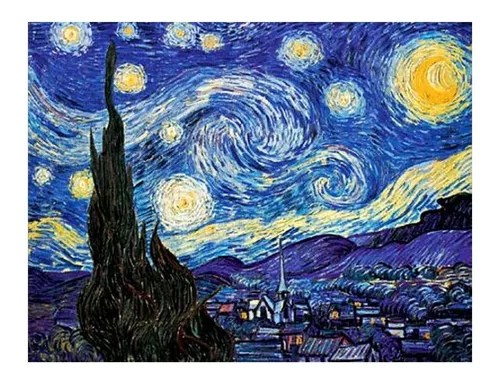
- Starry Night by Vincent van Gogh (1889):
- Reflects a yearning for transcendence and the interplay between chaos and beauty in the human experience.

4. Identity and Self-Discovery
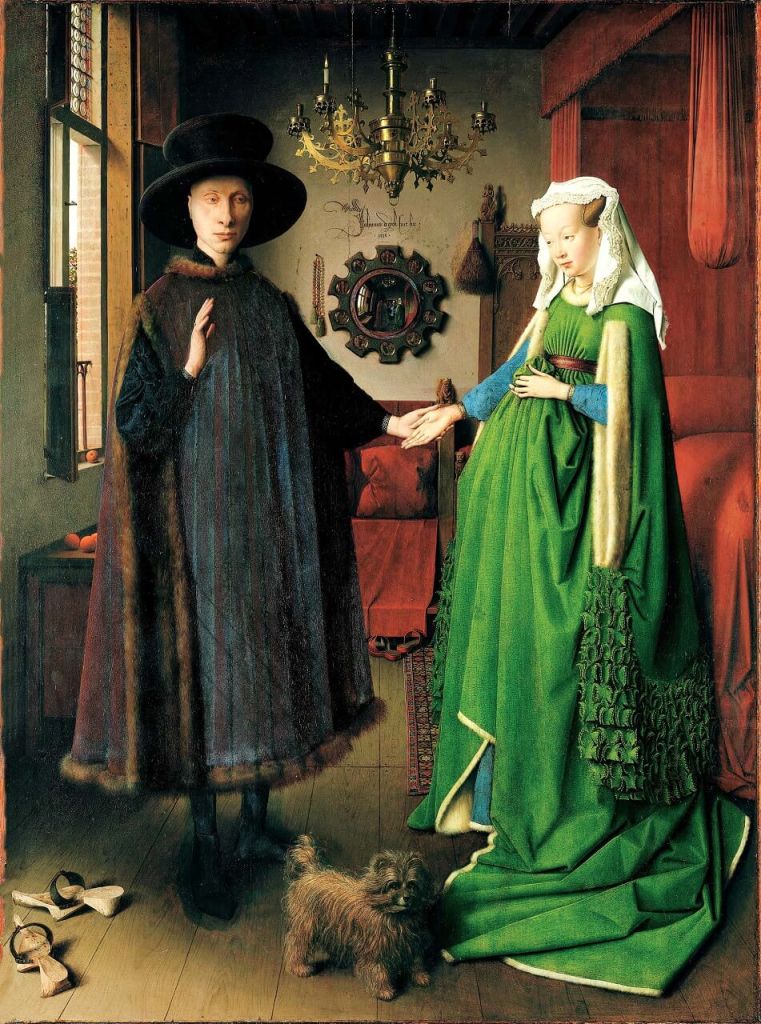
- Arnolfini Portrait by Jan van Eyck (1434):
- A detailed exploration of personal identity, relationships, and social roles through symbolism.
- Self-Portraits by Frida Kahlo:
- Her self-portraits often explore pain, resilience, and the search for identity in the face of adversity.

5. Love and Connection
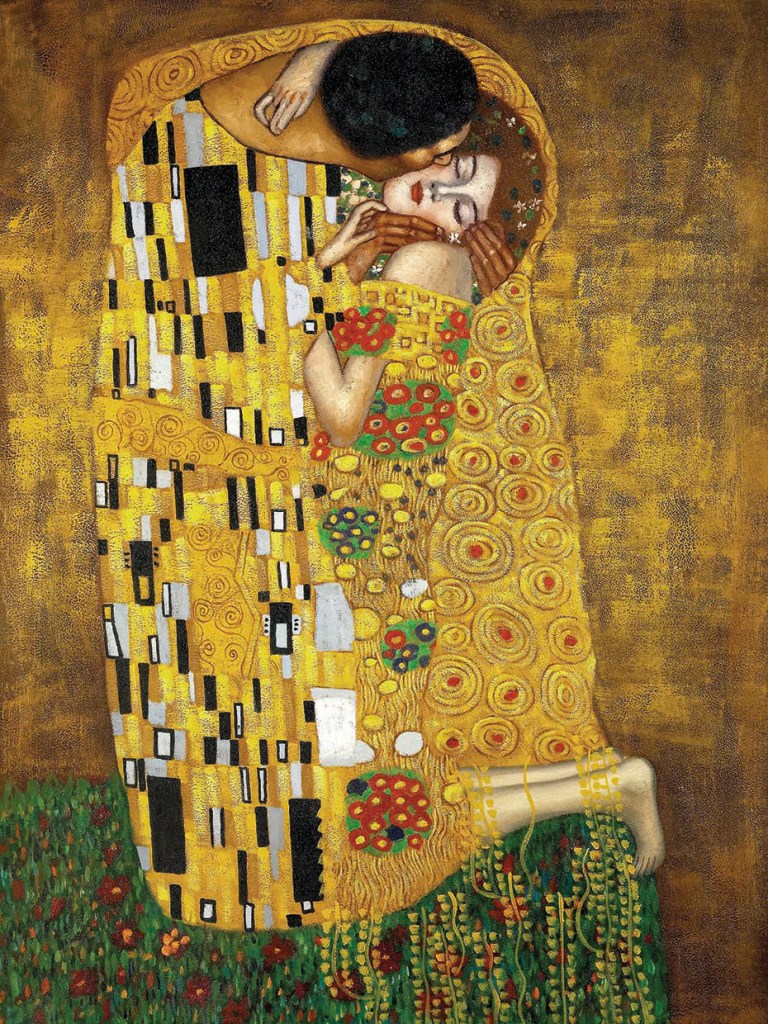
- The Kiss by Gustav Klimt (1907-1908):
- A celebration of love and intimacy, blending sensuality with spirituality.
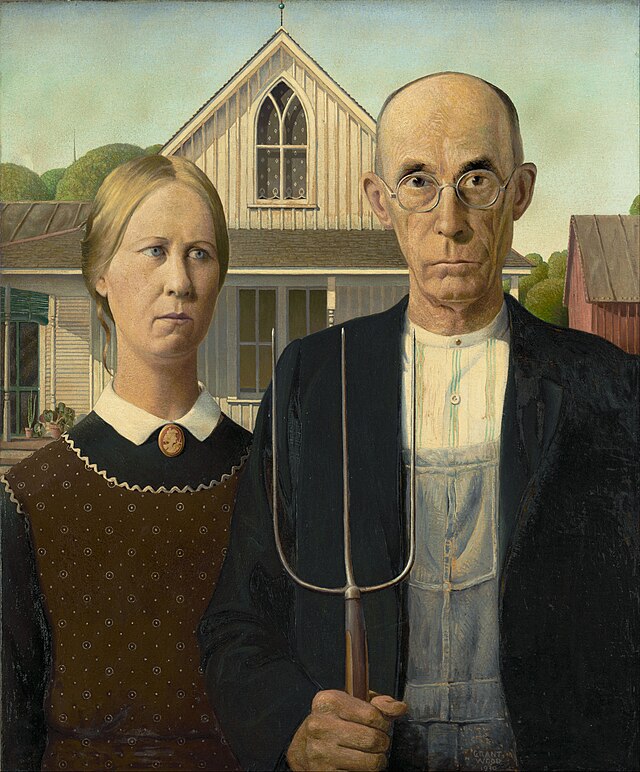
- American Gothic by Grant Wood (1930):
- Examines family dynamics, tradition, and the stoic endurance of rural life.
6. The Relationship with Nature
- The Hay Wain by John Constable (1821):
- Depicts harmony between humans and nature in the English countryside.
- The Oxbow by Thomas Cole (1836):
- Explores humanity’s impact on the natural world and the tension between wilderness and civilization.


7. Spirituality and Transcendence
- The Creation of Adam by Michelangelo (c. 1512):
- Highlights the connection between humanity and divinity, addressing questions of purpose and creation.
- The Wanderer Above the Sea of Fog by Caspar David Friedrich (1818):
- Evokes a sense of awe and introspection, symbolizing the search for meaning in the vastness of existence.


8. Conflict and Struggle
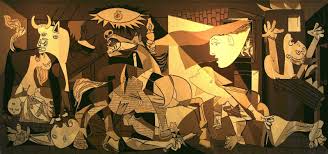
- Guernica by Pablo Picasso (1937):
- A powerful anti-war statement that explores the suffering caused by violence and conflict.
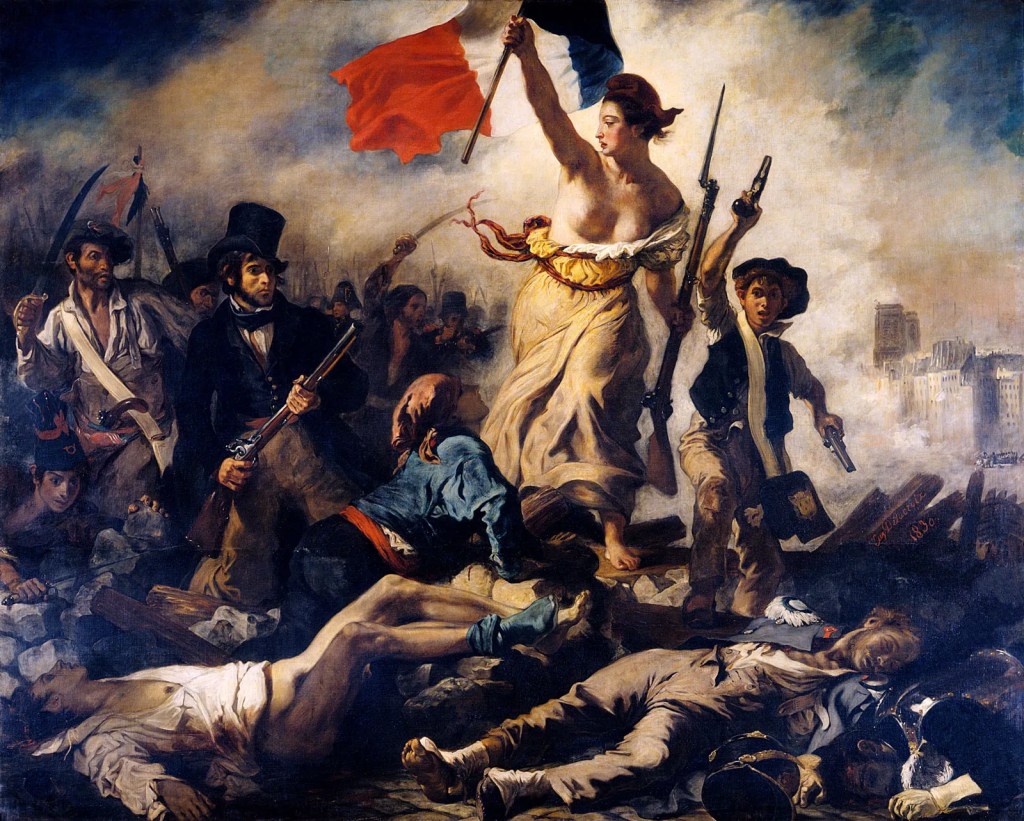
- Liberty Leading the People by Eugène Delacroix (1830):
- Depicts the struggle for freedom and the resilience of people fighting for their rights.
Andrew Wyath the world of Christina
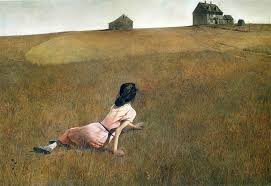
Andrew Wyeth’s Christina’s World (1948) is a profound example of a painting that explores the human condition, and it aligns beautifully with themes of resilience, isolation, and the yearning for connection and purpose.
How Christina’s World Reflects the Human Condition
- Resilience and Struggle:
- The central figure, Christina Olson, is depicted crawling across a vast, open field toward a distant farmhouse.
- Christina suffered from a degenerative muscular condition, and her pose symbolizes the struggle to navigate life despite physical limitations.
- The painting reflects human resilience in the face of adversity, embodying the question: “What do I do with what I have got?”
- Isolation and Longing:
- The expansive, barren landscape contrasts sharply with the small, fragile figure, evoking feelings of isolation and vulnerability.
- The distant farmhouse represents both a literal and symbolic goal—hope, safety, or a connection that seems just out of reach.
- This tension mirrors the universal human longing for belonging and purpose.
- Ambiguity and Universal Appeal:
- Wyeth’s decision to leave Christina’s face obscured invites viewers to project their own emotions and experiences onto the scene.
- This universality makes the painting a reflection of the human condition, as it speaks to themes of aspiration, struggle, and the will to persevere.
- Relationship with the Environment:
- The natural setting underscores humanity’s smallness in the vastness of the world, yet also highlights the intimate relationship between humans and their surroundings.
- The interplay of vulnerability and determination is central to the human experience.
Why Christina’s World Resonates
Wyeth’s masterpiece addresses core aspects of the human condition:
- The courage to move forward despite obstacles.
- The tension between isolation and hope.
- The intrinsic drive to make meaning of one’s circumstances.
This painting, while deeply personal to Wyeth and Christina Olson, has a universal emotional impact, making it an essential addition to any discussion of art that reflects the human condition
________________________________________________________________________________________________________________
Edward Hopper and Andrew Wyeth
There is a clear similarity between Wyeth and Hooper, as they are from the same American realist school.
However, if we exclude Christina’s painful disability, which is in a way central to Wyeth’s painting, the other things around her and in her subjective context overlap greatly with the themes that Hooper addresses, and I emphasize:
Lets delve deeper into the thematic overlaps between the works of Edward Hopper and Andrew Wyeth, particularly in relation to Wyeth’s iconic painting “Christina’s World.” Here are some key points:
Thematic Overlaps:
- Isolation, loneliness, and emotional detachment – Both artists powerfully capture the profound sense of solitude and disconnection experienced by their subjects.
- Existential yearning and the search for meaning – The figures in their paintings often seem to be grappling with a lack of purpose or fulfillment in their lives.
- Quiet, contemplative moments and the inner life – Hopper and Wyeth focus on the introspective, private moments that reveal the psychological and emotional states of their subjects.
- The impact of the physical environment – The settings and landscapes in their works serve as metaphors for the human condition, reflecting themes of isolation, emptiness, and the individual’s relationship to their surroundings.
Elements in “Christina’s World”:
- The solitary figure of Christina, alone in a barren landscape, evokes the sense of isolation and detachment found in Hopper’s paintings.
- The pose and gaze of Christina, with her back turned to the viewer, mirrors the introversion and emotional distance of Hopper’s figures.
- The dilapidated farmhouse in the distance, like the urban settings in Hopper’s works, suggests a sense of decay and the erosion of traditional ways of life.
- The overall composition and use of light and shadow create a mood of melancholy and contemplation similar to Hopper’s aesthetic.
Ambiguity and Multiple Interpretations:
- Both Hopper and Wyeth deliberately leave their paintings open to multiple interpretations, inviting the viewer to engage with the work and project their own experiences and emotions onto the scenes.
- This ambiguity allows for a deeper exploration of the human condition, as the viewer is compelled to grapple with the universal themes of loneliness, existential crises, and the search for meaning.
- The lack of definitive answers or resolutions in their paintings mirrors the inherent complexities and uncertainties of the human experience.
- This openness to interpretation encourages the viewer to reflect on their own lives and the shared struggles that define the human condition.
The thematic and stylistic parallels between Hopper and Wyeth underscore their shared artistic vision and their profound insights into the essential aspects of the human experience. Their works continue to resonate with viewers, offering a poignant and enduring exploration of the human condition.
Parallels and thematic overlaps
Significant parallels and thematic overlaps between the works of Edward Hopper and Andrew Wyeth, particularly in their shared exploration of the human condition.
Both Hopper and Wyeth were prominent American painters of the 20th century, and their respective bodies of work reflect a deep understanding and empathetic portrayal of the solitary, introspective aspects of the human experience.
The connections between Hopper’s paintings and Wyeth’s famous work “Christina’s World” are particularly striking:
- Isolation and Detachment:
- Like Hopper’s figures, the solitary figure of Christina in Wyeth’s painting conveys a profound sense of isolation and emotional detachment from her surroundings.
- Both artists capture the quiet, contemplative moments that reveal the inner lives and psychological states of their subjects.
- Existential Longing:
- The pose and gaze of Christina in Wyeth’s painting suggest a yearning for meaning, purpose, or connection that resonates with the existential ennui found in Hopper’s works.
- The barren, rural landscape serves as a metaphor for the spiritual and emotional emptiness that can characterize the human condition.
- Ambiguity and Interpretation:
- Wyeth’s “Christina’s World,” like Hopper’s paintings, is marked by an ambiguity that invites multiple interpretations and reflections on the human experience.
- The viewer is left to ponder the inner life and motivations of the subject, much like Hopper’s enigmatic figures.
Both Hopper and Wyeth shared a deep fascination with the complexities of the human condition, and their paintings offer profound and poignant commentaries on themes of isolation, loneliness, and the search for meaning in the modern world. The striking parallels between their artistic visions underscore the shared human experiences that transcend individual artistic styles and approaches.
Relevant works of Edward Hopper about the human condition
Edward Hopper is renowned for his evocative depictions of the human condition, often highlighting themes of isolation, solitude, and quiet introspection in the modern world. His paintings resonate universally, capturing the emotional and psychological landscapes of individuals within their environments. Here are some of his most relevant works that delve into the human condition:
1. Nighthawks (1942)
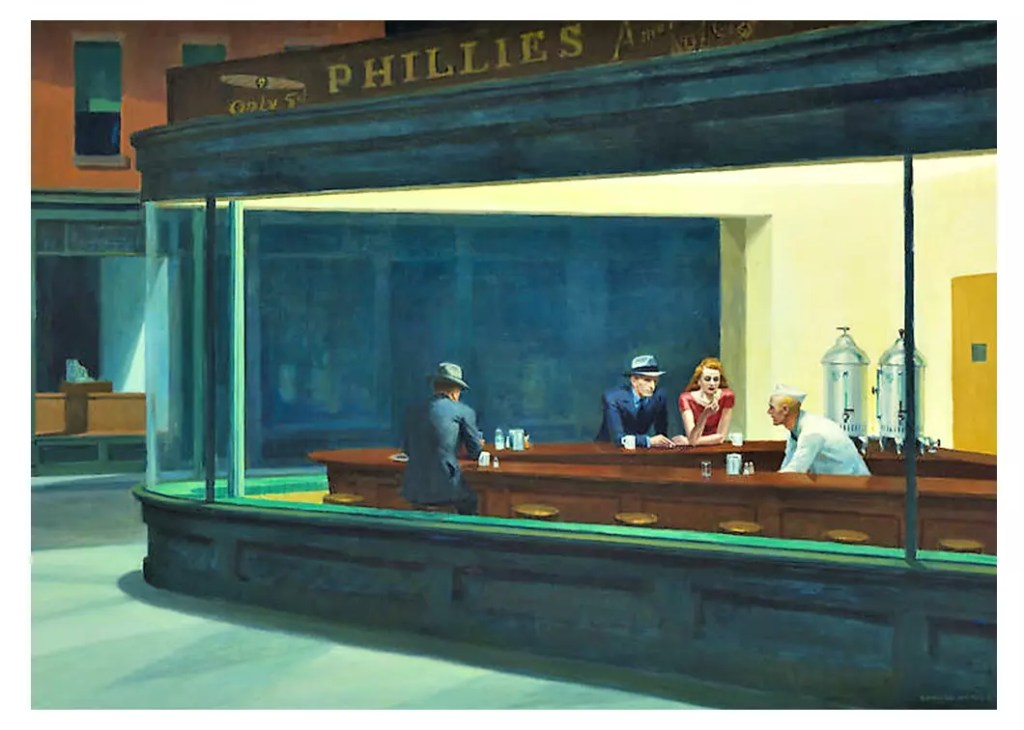
- Theme: Isolation in urban life.
- Description: Depicts a late-night diner with a few customers seated apart from one another. The stark artificial lighting contrasts with the dark, empty streets outside.
- Significance: This painting symbolizes urban alienation and the lack of meaningful connection in a bustling city. The characters appear close physically but disconnected emotionally, a hallmark of modern loneliness.
2. Morning Sun (1952)
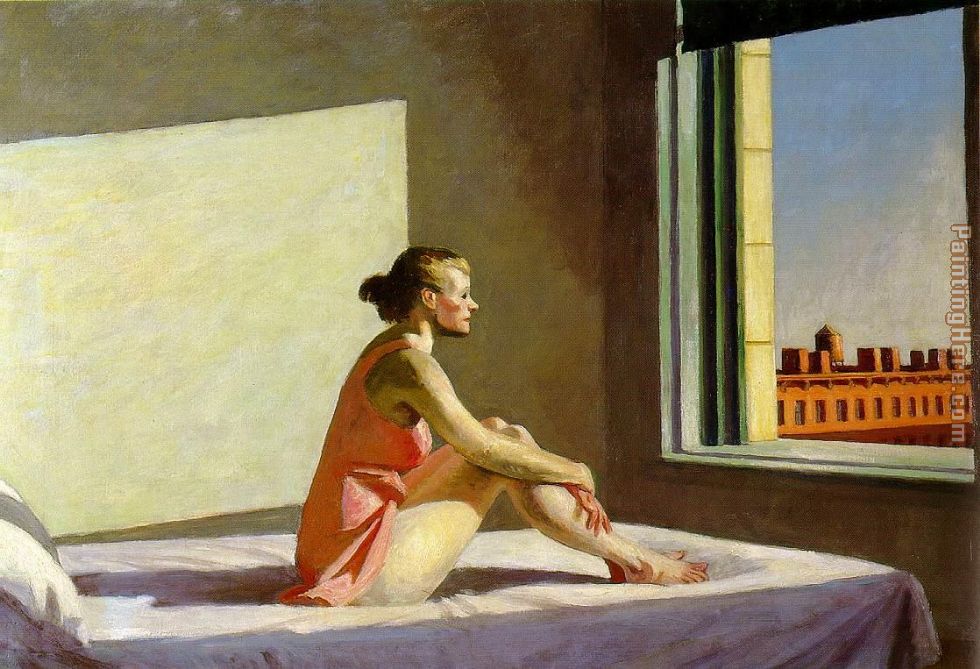
- Theme: Introspection and longing.
- Description: A woman sits on a bed bathed in sunlight, gazing out of a window at a bare cityscape.
- Significance: The simplicity and stillness of the scene evoke themes of self-reflection, routine, and existential longing. It captures a moment of quiet contemplation about life and one’s place in the world.
3. Automat (1927)
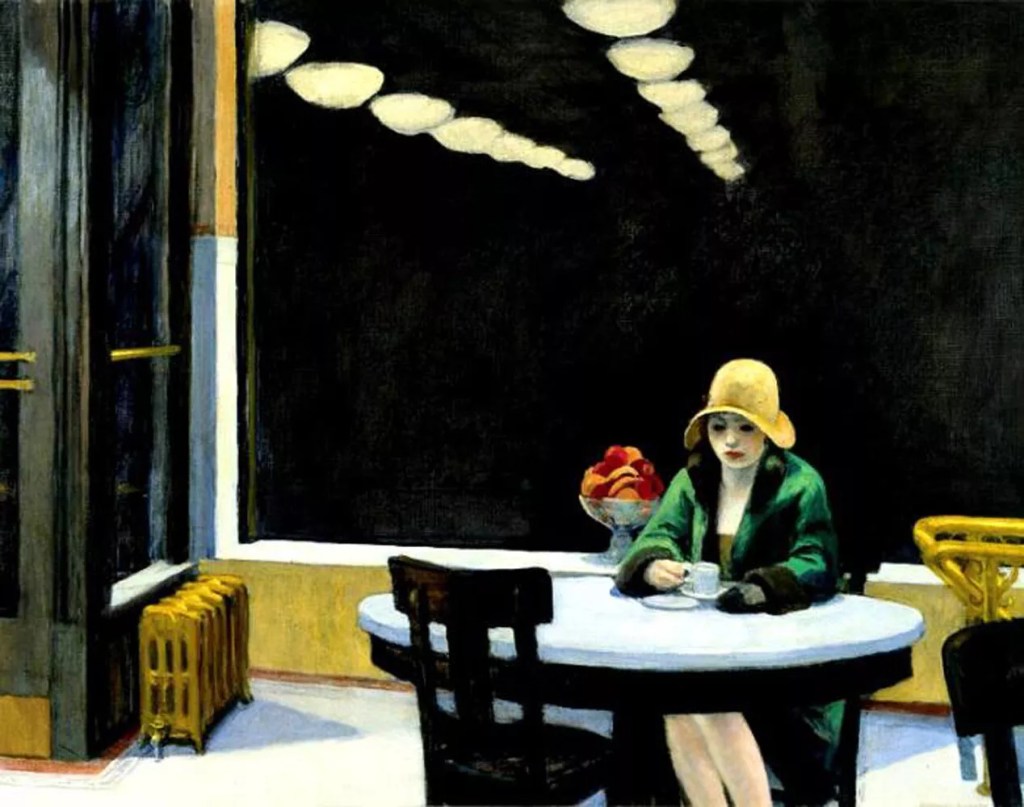
- Theme: Solitude and anonymity.
- Description: A woman sits alone at a table in an automat, gazing into her coffee cup, with her reflection visible in the window behind her.
- Significance: This work portrays the loneliness of individuals in an increasingly impersonal and mechanized world, emphasizing emotional isolation in modern society.
4. Room in New York (1932)

- Theme: Disconnection in relationships.
- Description: A man and a woman share a room, yet each is absorbed in their own activity—he reads the newspaper while she plays the piano, creating an emotional distance.
- Significance: Highlights the quiet estrangement that can occur even in intimate relationships, reflecting the complexities of human interaction.
5. House by the Railroad (1925)
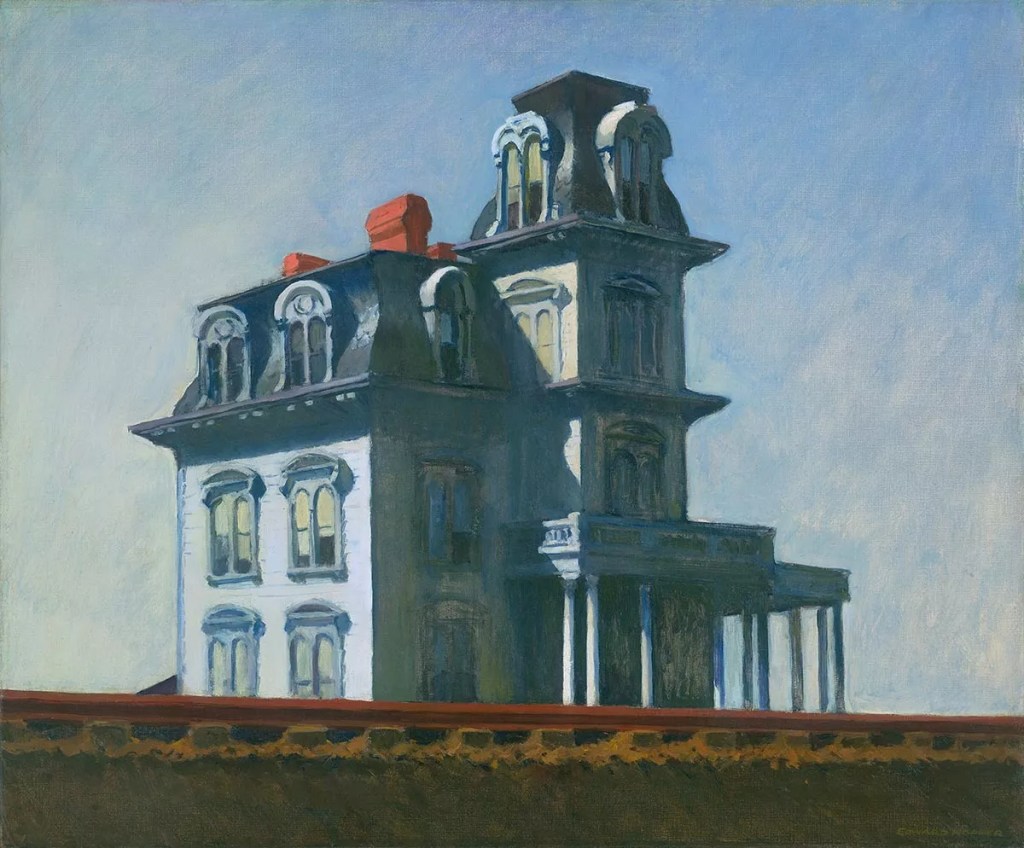
- Theme: Abandonment and change.
- Description: A lone Victorian house stands near a railroad, starkly lit and seemingly detached from its surroundings.
- Significance: Represents the passage of time and the isolation brought by industrialization. It conveys a haunting sense of disconnection from the past.
6. Cape Cod Evening (1939)

- Theme: Estrangement and nature.
- Description: A man and a woman sit outside their rural home, looking in different directions. A dog is alert and attentive to something unseen.
- Significance: The painting evokes a sense of emotional distance and the quiet tension between individuals and their environment.
7. Office at Night (1940)

- Theme: Ambiguity and societal roles.
- Description: A man sits at a desk reading, while a woman stands nearby. The sparse office environment hints at unspoken tension between them.
- The sensual way Hopper painted the woman suggests seduction and sex
- Significance: The painting captures the monotony and subtle power dynamics of professional relationships, leaving viewers to imagine the story behind the scene.
8. Gas Station (1940)
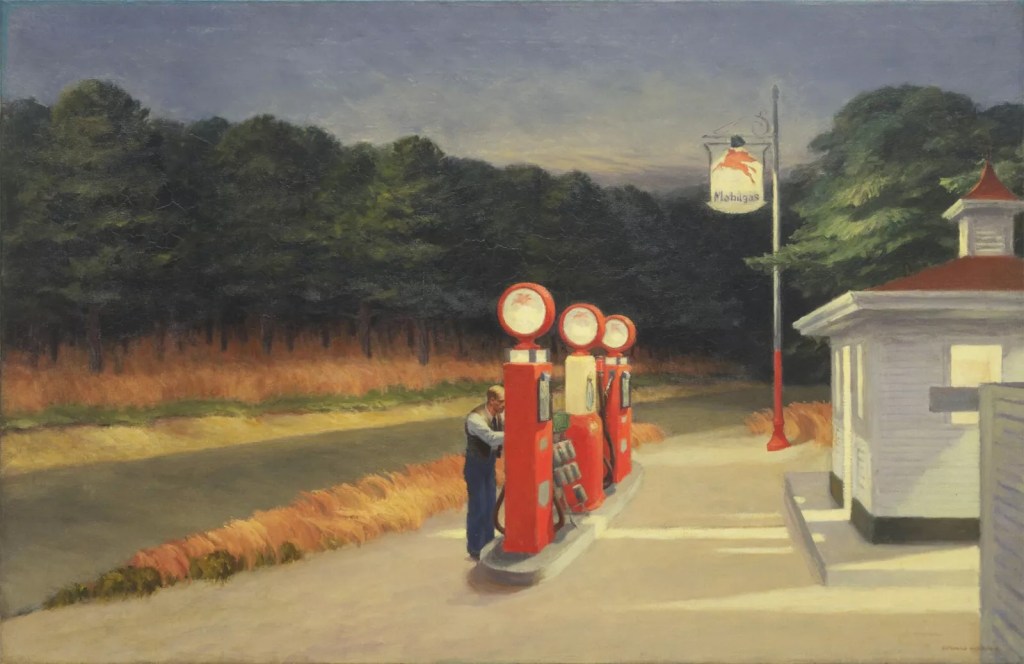
- Theme: Solitude and transition.
- Description: A lone gas station attendant stands by his pumps at dusk, surrounded by an empty landscape.
- Significance: Reflects the solitude of modern work and the transient nature of life, as the gas station serves as a metaphorical crossroads.
9. Chop Suey (1929)
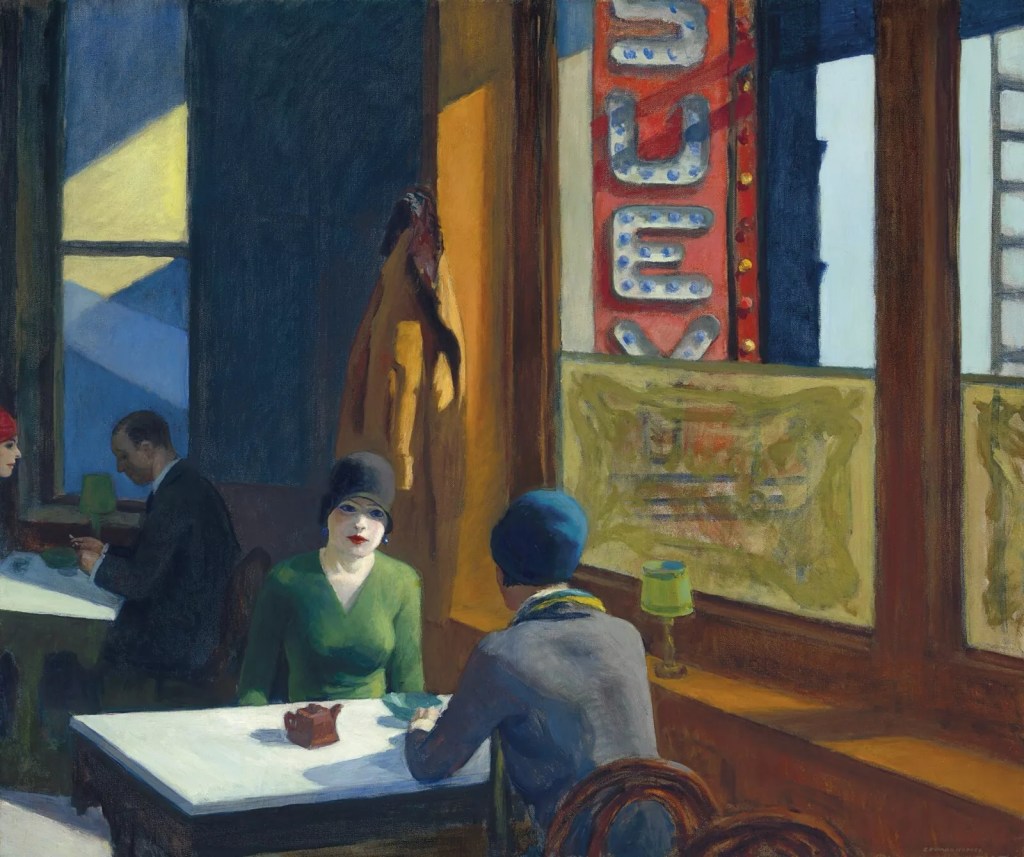
- Theme: Urban life and fleeting connections.
- Description: Two women sit at a restaurant table, seemingly mid-conversation, while the background reveals other diners and the urban environment.
- Significance: Balances themes of connection and alienation, focusing on the fleeting nature of relationships in an urban setting.
10. Hotel Room (1931)

- Theme: Transition and solitude.
- Description: A woman sits on the edge of a hotel bed, reading a piece of paper, her suitcase beside her.
- Significance: Evokes a transient and melancholic moment of being between places, both literally and emotionally, emphasizing the uncertainty of modern life.
Why These Works Matter
Hopper’s paintings are timeless because they address universal themes of:
- Loneliness and Isolation: Even in shared spaces, individuals often appear emotionally distant or disconnected.
- Routine and Reflection: Quiet moments of introspection capture the beauty and melancholy of everyday life.
- Modern Alienation: Hopper portrays the challenges of maintaining meaningful connections in an increasingly impersonal world.
Each work invites viewers to reflect on their own experiences of solitude, connection, and the passage of time, making Hopper one of the most poignant interpreters of the human condition in art.
Edward Hopper’s paintings and the themes of the human condition in more depth:
Loneliness and Isolation:
- Hopper’s figures are often solitary, introspective, and physically or emotionally isolated, even when in the presence of others. This conveys a profound sense of loneliness.
- In works like “Nighthawks” and “Office at Night,” the characters appear disconnected, trapped in their own private worlds despite being in close proximity.
- This isolation reflects the growing social alienation and atomization of modern urban life.
Existential Ennui:
Ennui is a French term that describes a feeling of listlessness, boredom, or dissatisfaction arising from a lack of excitement or engagement in life. It often conveys a sense of existential weariness or a feeling that life is monotonous and unfulfilling
- Many of Hopper’s characters exhibit a palpable sense of ennui, boredom, and dissatisfaction with their lives.
- Figures like the woman in “Morning in a City” or the woman in “Automat” seem to be grappling with a lack of meaning or purpose.
- This ennui speaks to the existential crisis and spiritual emptiness that can arise in the face of modernity’s disruption of traditional sources of meaning.
Voyeurism and the Gaze:
- Hopper often places the viewer in the position of a voyeur, peering into private, intimate moments of his subjects.
- This creates a sense of unease and complicity, as we become aware of our own act of observation and the subjects’ vulnerability.
- The gaze in Hopper’s paintings reflects broader cultural shifts in the 20th century around privacy, surveillance, and the commodification of the individual.
Ambiguity and Uncertainty:
- Hopper’s paintings are marked by a profound sense of ambiguity
I have posted a site blog on Edward Hopper
Last but not least Norman Rockwell
The opposite of loneliness is often considered to be connection or belonging, though it can take many forms depending on the context. Here’s a deeper exploration of what might counteract loneliness:
1. Connection
- Being emotionally, physically, or spiritually connected to others.
- It doesn’t necessarily require being surrounded by people; even one meaningful connection can counteract loneliness.
2. Belonging
- Feeling part of a community, group, or shared purpose.
- A sense of belonging comes from feeling accepted and valued in relationships or social settings.
3. Intimacy
- Close, personal bonds where individuals feel deeply understood and supported.
- This could be romantic, familial, or platonic in nature.
4. Companionship
- The presence of someone to share life with, whether through conversation, shared activities, or quiet togetherness.
- Companionship provides a comforting presence and a sense of solidarity.
5. Solitude (as a positive state)
- The enjoyment of being alone without feeling lonely.
- Solitude can be a fulfilling opposite to loneliness when chosen intentionally and accompanied by a sense of peace or self-connection.
6. Fulfillment
- Engaging in meaningful work, passions, or hobbies can alleviate loneliness by providing a sense of purpose.
- Feeling connected to a greater goal or mission counters isolation, even in the absence of direct interpersonal relationships.
7. Community
- Being part of a larger social structure, such as a neighborhood, workplace, religious group, or club, provides shared experiences and mutual support.
8. Love
- Love in its many forms—romantic, platonic, familial, or even self-love—is a powerful antidote to loneliness.
- It fosters a sense of care, connection, and mutual regard.
While these concepts counter loneliness, they also highlight the multifaceted nature of human relationships and emotions. The key lies in fostering quality connections, both with others and with oneself.
Norman Rockwell as opposite to Wyeth and Hopper
The same way Wyeth and Hopper depicts loneliness, and the feelings we described above, the paintings of Norman Rockwell characterize the opposite
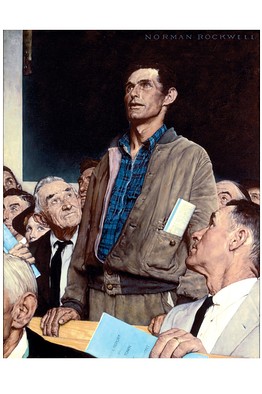
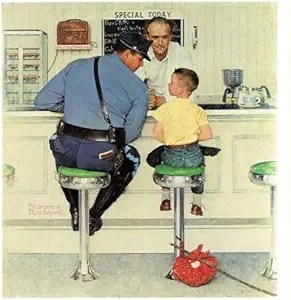
Norman Rockwell’s paintings often embody the feelings of connection, belonging, companionship, and love, making them a stark contrast to the themes of loneliness and isolation depicted by Andrew Wyeth and Edward Hopper. Rockwell’s works celebrate the positive and communal aspects of the human condition, often presenting an idealized, warm, and nostalgic vision of life.
How Norman Rockwell’s Paintings Reflect These Opposites
Belonging and Community:
Love and Intimacy:
- Examples:
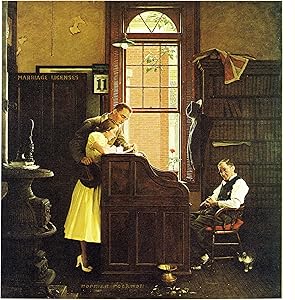
- The Marriage License (1955): A couple and a clerk share a quiet, tender moment as they prepare for the next chapter of their lives.
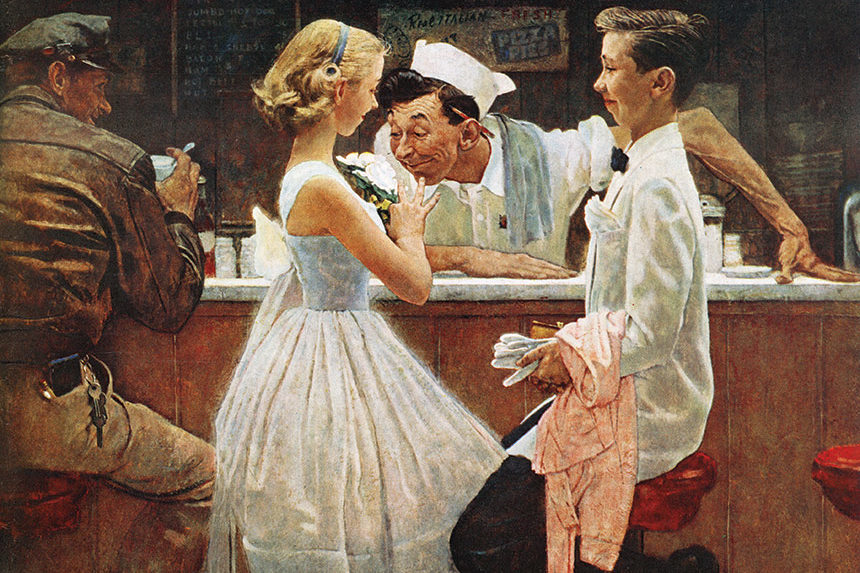
- After the Prom (1957): Two young people share an intimate, celebratory moment in a modest diner.
- Interpretation:
- These paintings celebrate human relationships and the joy found in intimate, meaningful connections.
Companionship and Everyday Life:
- Examples:
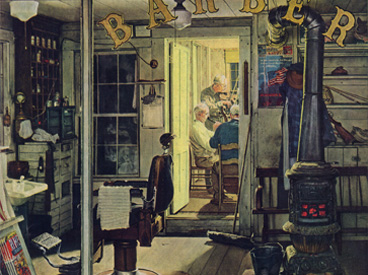
- Shuffleton’s Barbershop (1950): Friends gather to play music in the back of a barbershop, capturing the warmth of companionship in simple routines.
- Home for Christmas (1967): A small-town street scene bustling with life, showcasing community during the holidays.
- Interpretation:
- Rockwell’s works often reflect the joy and comfort of shared traditions and daily interactions.

Nostalgia and Fulfillment:
- Examples:
- Rosie the Riveter (1943): Celebrates a woman’s empowerment and contribution to a collective cause.
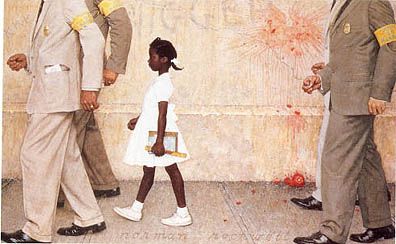
- The Problem We All Live With (1964): Despite its serious subject matter, the painting reflects courage, solidarity, and progress.
- Interpretation:
- His works often idealize moments of fulfillment, portraying them as aspirational and deeply human.

Rockwell’s Artistic Style and Emotional Tone
- Warmth and Optimism: Unlike the stark, melancholic tones of Hopper or the quiet resilience of Wyeth, Rockwell’s palette and compositions are inviting, colorful, and imbued with optimism.
- Narrative Storytelling: Rockwell’s scenes often tell clear stories of connection, creating a sense of shared humanity.
- Accessible Idealism: While Hopper and Wyeth lean toward introspection, Rockwell leans toward celebration, offering viewers a comforting vision of community and togetherness.
Why Rockwell’s Work Complements Wyeth and Hopper
Where Hopper and Wyeth delve into solitude and isolation, Rockwell explores the antidotes: connection, unity, and joy. Together, their works provide a balanced and profound exploration of the human condition, reflecting both its challenges and its triumphs.
I did a post on Norman Rockwell and his role in the context of how the United States became the greatest nation in the world. It’s in Portuguese, but you can use Google’s automatic translator.
 O Sentido da Vida - The Meaning of life