Roque E. de Campos / Edit

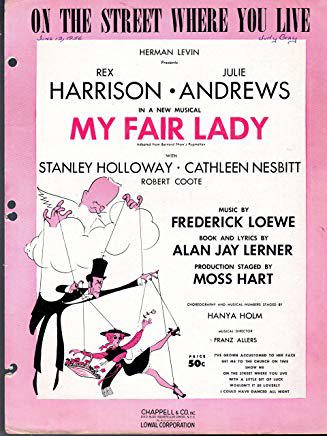
My Fair Lady is a musical based on Pygmalion by George Bernard Shaw, with book and lyrics by Alan Jay Lerner and music by Frederick Loewe. The show premiered on Broadway in 1956 to great acclaim and commercial success, setting a record for the longest run (2,717 performances over six and a half years) for any Broadway production up to that time.
When the play was adapted for film by Warner Bros. in 1964, Audrey Hepburn played the lead role previously played by Julie Andrews.
The main song from this musical is “On the Street Where You Live.”
Vic Damone recorded his version of “On the Street Where You Live” around the time of the play’s premiere in 1956. The song reached number 4 on the Billboard chart.
Nat King Cole also recorded it, and it’s that version that I identify with.
How and why do I identify this song with the following experience?
For me, this song has always been and always will be related to the first time I managed to write a diagnostic for an IBM mainframe, in this case the 4341.
I was assigned to join a group that was supposed to develop diagnostics to check if the machine’s hardware was working correctly and, if not, what was wrong, what exactly wasn’t working.
In simple terms, it was about debugging cards and identifying which integrated circuit was failing.
I don’t know exactly why, I think it was experience from previous developments, but the deadline to complete the diagnostics was 18 months, with six months to understand the development tools, present a project, and the rest to actually write the diagnostics. I arrived late, in March 1978, and started writing diagnostics in mid-1979.
Our Brazilian team consisted of three people, myself and two others, who quit and asked to be transferred to other areas. I arrived after them. The person assigned to the task was a USP graduate with a degree in Computer Science. He went directly from Rochester to Endicott, where a project was aborted because the Brazilian government didn’t approve it, so I returned to Brazil. It wasn’t clear to me what happened, and I wasn’t interested at the time, but I believe he couldn’t complete the task, and I stepped in as a backup without expectations, so as not to leave the team without anyone Brazilian. The second person was completely lost, and I don’t know what led him there, as he returned to Brazil almost immediately.
I stayed, but I thought the same thing would happen to me; that is, it was beyond my capabilities, and I wouldn’t be able to do what was expected, which was to write a diagnostic program that would analyze the computer hardware, detect whether it was working correctly, and identify the faulty part.
I was responsible for the K and L cards, or the 4341 shifter.
Basically, the 4341’s logic hardware was a bunch of cards full of high-density integrated circuits, assembled in alphabetical order.
The cards were mounted on Endicott machines, and their debugging was done directly on the machine, which returned the cards with problems for rework.
My job was to create a program that diagnosed which modules on these cards were not working and needed to be repaired or replaced.
IBM assembled temporary teams to do this type of work, because once it was done, it didn’t need to be touched again, and usually the people from the countries where a particular machine was going to be manufactured were the people who were part of this team.
The market where this machine would be sold was divided worldwide into three parts: the United States, or domestic market, Europe, and the rest, which was called Asia Far East.
Brazil was part of Asia Far East and was responsible for producing this machine for that area.
Europe would be supplied by Germany, and their team was led by an arrogant German who bluntly stated that he thought Americans didn’t understand anything. I later learned that they were very helpful in the project, even building an enlarged prototype that was walkable inside.
Since two of the three Brazilians had already been ruled out, I ended up having to compete with him to see who would do the K and L card diagnoses, as I had clearly told the coordinator that I was apprehensive and didn’t understand what I needed to do. The coordinator was extremely kind, calmed me down, and said he would guide me, which he did by recommending books and explaining how the virtual process worked, since he himself had helped create the virtual machine and designed the operating system that controlled all the diagnoses. The German despised him, and he was very clever and humble and didn’t pay any attention.
It turned out that the German quickly designed a very elegant, frankly incomprehensible program, even using his family’s names in the pointers (!), and gave up, as he considered it a waste of time and simply hardly showed up anymore, and at the monthly meetings we had, when he did appear, he seemed to yawn.
I eventually figured out how to design the program and did it in the simplest way possible, actually guided by the coordinator, who said that we would leave and there would be no one to explain what was written in case of any doubt.
When the deadline passed and we had to decide on the package to start working on, the coordinator got his revenge… I don’t remember the exact words, but it was something like this: “We have here now Mr. …’s proposal, elegant, sophisticated, as is everything the German breed does. On the other hand, we have Mr. Roque’s project, simple, more in line with our guideline of not complicating things, but which solves the problem, something that Mr. …’s program doesn’t do, because instead of designing an operating system to support an infinite number of programs, as Mr. Roque did, he chose to use the commands embedded in the Assembler masks, which, although they support a large number of pointers, cannot cover the needs we have for the K and L cards.”
The German guy took it apart… he left and I was left alone and I wrote 500,000 lines of code, and I was the one who produced the most…
To make a long story short, since diagnoses written virtually with development tools are never the same as the hardware, which is the final destination, the validation of what we did with the software tools virtually had to be on a prototype, that is, the real machine. Prototypes were highly sought after, and they ran in three shifts, 24/7, that is, every day and every hour. I chose to work the third shift, which in practice was from three in the afternoon to three in the morning, when I didn’t have to wait for a machine to become available to test what I had written. As a result, I always came back in the early hours of the morning and loved to stop at a diner car and have a latte with donuts and go home to sleep.

The first time I actually managed to do what was expected of me—that is, to detect what wasn’t working, indicate it in the hardware, and actually be that part—I got home around 4 in the morning, ecstatic, hugged my wife who was completely sleepless, and said: I did it!
I turned on the TV, as I always did, which in the early morning hours showed reruns, old shows that I liked to watch and would watch until I fell asleep. However, I don’t know why, I don’t know if it was on TV or if I turned on the stereo at home, but suddenly “On the Street Where You Live” by Nat King Cole came on. The song hit me like a lightning bolt. Underneath my skin, it was the epitome of what I had just done. To this day, I’ve never quite understood why this happened, and it always happens whenever I hear that song, which represents that moment I lived through.
Today, February 2026, something incredible happened that clarified for me what this song meant and means for that moment.
Now, in February 2026, I was looking for the biography of Vic Damone, a singer I admire, when I came across the following information: Vic Damone revealed the following about his recording of “On the Street Where You Live” in his 2009 autobiography, “Singing Was the Easy Part”:
“When I sang, I felt like I wasn’t singing to a girl, but to God. I was on the street where He lived.”
And he added that he was giving thanks—on stage, where God had given him the most important thing in his life, which was his voice and his gift for singing. He also noted that the audience could sense that something unusual was happening—the room fell completely silent.
Now, faced with this revelation, I realized that the same thing had happened to me; that is, he and I redirected a love song towards something greater, transforming “you” into God and the street into something sacred. This is an attitude of someone who feels that my talent, and his, is not something we ourselves had conquered, but rather something given to us by God.
This, in both his case and mine, implied destiny and self-discovery. Right in the first verse, the metaphor that I felt emerges, and it had nothing to do with the love that the character discovers he has for the heroine of the musical, and the verses continue to resonate with this logic due to the feeling of admiration and astonishment that the discovery brought:
I’ve walked down this street many times before
, but the pavement always remained firm beneath my feet.
Suddenly, I find myself several stories high,
knowing I’m on the street where you live. (I’ve capitalized it because now I know what it’s about.)
Are there lilacs in the city center?
Can you hear a lark anywhere else in the city?
Does the charm emanate from every door?
No, it’s only on the street where you live.
Oh, the overwhelming feeling
Just knowing that somehow You’re near
The irresistible feeling
That at any second You could suddenly appear
People stop and stare, but it doesn’t bother me.
Because there’s no other place on Earth I’d rather be.
Let time pass, I won’t care if I
can be here on the street where you live.
People stop and stare, but it doesn’t bother me.
Because there’s no other place on Earth I’d rather be.
Let time pass, I won’t care if I
can be right here on the street where you live.
It wasn’t the love of my life, but rather my destiny, something that transcended my intellect and education, as it consisted of deeply understanding how a computer works, something complex and requiring a great deal of intellectual capacity, something I doubted for a long time that I was capable of doing. I almost gave up on the project completely, simply because I couldn’t understand what it was about.
“The asphalt had always remained beneath my feet before”—that’s the key phrase. I had overcome technical challenges before. I knew the ground. But this experience of being able to write the diagnosis lifted me above it. Suddenly, I was “several stories high”—not because of love as in the song, but because something within myself that I doubted existed appeared and surprised me.
This is a profound moment of self-discovery, and quite different from romantic love. What I discovered about myself that night in that data center—which, pushed beyond my perceived limits, which I thought would lead to my collapse, I managed to overcome—that defined me forever.
The uncertainty I was experiencing is also important because of the consequences it has for my professional future.
I almost gave up. This means that victory wasn’t easy, peaceful, or inevitable. It was genuinely uncertain until it wasn’t. And that’s exactly the kind of experience that reshapes how we see ourselves.
It was the finishing touch to my persona and what defined me at IBM.
The music found me at exactly the right moment—when the asphalt seemed to have just disappeared, as I felt it was happening due to my inability to overcome the obstacle, but after conquering it, I was still flying high, at an altitude beyond what I judged my ability to fly, something I didn’t suspect was possible and doubted I was capable of doing.
To fully understand the grace I received, and the obstacle I had to overcome, would be too complicated and lengthy to explain here, but for those who are curious, this video explains what Large Scale Integration is, which was the technology that IBM first used in the 4341. Although the video doesn’t present, in its essence, the hardware revolution that it describes, it was what I faced and what was being diagnosed by my programs.
 O Sentido da Vida - The Meaning of life