Edward Hopper and Norman Rockwell created through their paintings a very special kind of reality associated with the american scene and are excellent examples to discuss reality and visual arts.
I did a post/blog about about Edward Hopper where I discussed extensively his art and you can find pratically everything he painted. When his wife Jo Hopper died, she bequeathed all of Edward’s work, as well as all her own, to the Whitney Museum – over 3,000 pieces in total what makes him a very special case because his wife donated almost all of his pintings to a single institution.
I didn’t do a post/blog on Norman Rockwell, but I discussed extensively in some posts the relation of the image he depicted about the american scene, specially during the WWII and the Golden Age or the Post War era.
From both of these sources I will separate contexts that allow us to better understand how the point of view converts reality and the image that is created of it.
Edward Hopper
The reality that he was inserted in and probably the one we would perceive can be understood through these two videos:
In the first video, I call special attention to the real place where he took his image to create perhaps his most famous painting: Night Hawks. To that please add How Edward Hopper Storyboarded ‘Nighthawks’. Since storyboard is a cinema thing, let’s hear from a filmmaker (Wim Wenders) how he perceives Edward Hopper in: TWO OR THREE THINGS I KNOW ABOUT EDWARD HOPPER. In this post, I call special attention to the surprise that Wim Wenders had upon discovering Edward Hopper and his explanation of why Hopper is a model of how one can see the world.
In the second video, Mrs. Jennifer Tipton, among other very interesting considerations, says something that perhaps define Edward Hopper: “He uses light in an inexpressible way – in a way that makes you feel something that is very difficult to articulate.”
From Hopper’s point of view and to make it easier for the reader you can examine the following subjects from which Hopper is famous which are a testimony to my quest about the image and reality:
Edward Hopper and the American Hotel
Edward Hopper Women It should better be written woman… From 1924 to his death in 1967, Hopper painted women who were shadow-faced, round-contoured ciphers. In the world of his imagination, they stayed up all night, poring over cups of coffee, lost in thought at the movies, undressing next to a radiator or lingering in the office with their boss, permanently stuck in some noir urban peepshow. Hopper’s women never age, but his wife, their only model, was not so immune. After 25 years of marriage, she bemoaned ‘time passing, passing, drop by drop of one’s life blood – hair greying, fashions changing, an entirely new slant on art rampant and 25 years of my life gone’.
Edward Hopper and American Solitude
Norman Rockwell
I know that academia shuns and despises realism in favor of modern abstract art and for some very good reasons which me included accept but, to be educated and put it blandly, while realism remains an important and respected style within the broader art world, the preference for modern and abstract art in academic and critical circles is influenced by a combination of historical shifts, philosophical trends, institutional support, and market dynamics. This does not mean that realism is disregarded entirely, but rather that abstract and modern art have been more prominently aligned with the values and interests of the contemporary art establishment.
It is obvious that Rockwell was almost completely unaffected by the revolutionary events in painting that occurred during his lifetime. If we are to compare it with Edward Hopper (1882 – 1967), we will feel that where Hopper, who also represented American life in a realistic way, albeit with some degree of abstraction, expressed coldness, alienation, separation, and uncertainty, Rockwell showed joy, sociability, and warmth. Most 20th century artists discovered the need to distance themselves from society, especially in the abstraction of imagery, creating worlds that exist only inside people’s heads. Especially people disturbed by the direction civilization has taken. Rockwell didn’t, he placed himself at the center of average American values, allowing himself only a few humorous digs here and there and into the simplicity of the naivety of the young or the conservatism of the older generation. He was, therefore, much more of an insider to his large audience as he was excluded from the avant-garde of American artists (or any other nationality).
While Rockwell’s early works often focused on idyllic and idealized scenes of American life, his later works shifted towards more serious and socially conscious themes. This change was partly influenced by his departure from The Saturday Evening Post and his subsequent association with Look magazine, which allowed him more freedom to explore social issues.
Norman Rockwell’s concern for social justice bedame evident in his powerful and evocative paintings addressing civil rights and racial equality. His later works reflect a deep commitment to highlighting the struggles and injustices faced by marginalized communities, marking a significant shift from his earlier, more nostalgic depictions of American life.
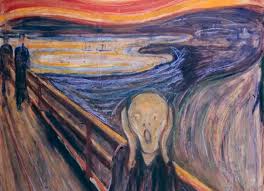
We can understand all this well when we see that The Scream of the Norwegian Edvard Munch was recently sold for 120 million dollars while Norman Rockwell highest price for one of his paintings reached fairly 50 million dollars.
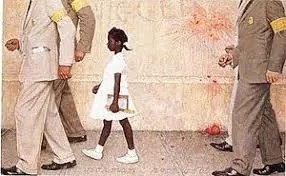
Norman Rockwell’s paintings addressing civil rights and racial equality
“The Problem We All Live With” (1964)
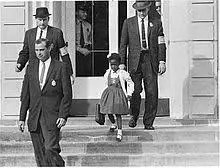
- Description: This painting depicts Ruby Bridges, a six-year-old African American girl, being escorted by U.S. Marshals to an all-white school in New Orleans, highlighting the issue of school desegregation.
- Impact: The painting is considered one of Rockwell’s most poignant works on civil rights and remains an iconic image of the struggle for racial equality in America.
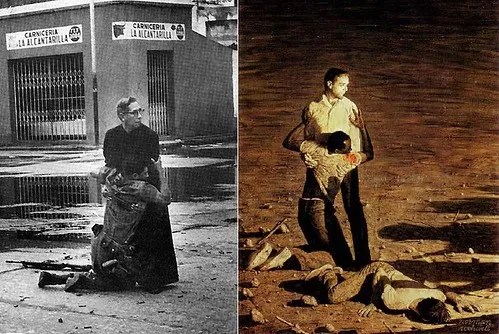
“Southern Justice” (Murder in Mississippi) (1965)
- Description: This painting portrays the brutal murder of three civil rights workers—James Chaney, Andrew Goodman, and Michael Schwerner—by members of the Ku Klux Klan in 1964.
- Impact: It serves as a stark reminder of the violent resistance to civil rights efforts and Rockwell’s commitment to addressing these critical issues.
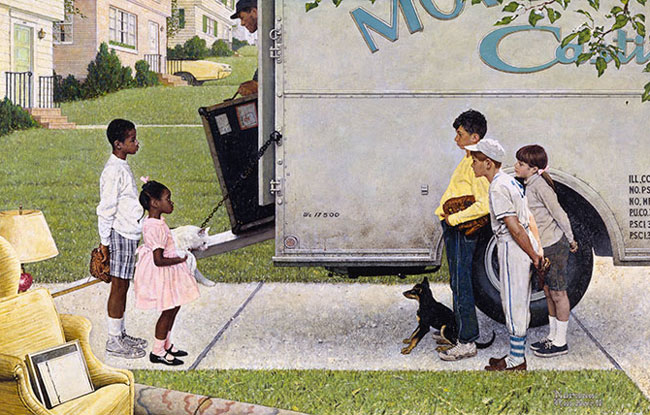
“New Kids in the Neighborhood” (1967)
- Description: This painting shows two African American children moving into a predominantly white neighborhood, capturing a moment of integration and the social tensions surrounding it.
- Moving Day depicts the integration of Chicago’s Park Forest suburban community. The children examine each other with curiosity and it appears likely that they will soon be friends. However, the face appearing from behind a window curtain make us wonder how the adults will react.
- Impact: The work reflects Rockwell’s sensitivity to the everyday realities of desegregation and racial integration.
Norman Rockwell goes beyond that.
The Four Freedoms.
President Franklin D. Roosevelt’s “Four Freedoms” speech, delivered on January 6, 1941, was a call to action for the United States and other democracies to work together to defend four essential freedoms around the world. These four freedoms were freedom of speech, freedom of worship, freedom of will and freedom of fear.
President Roosevelt argued that these freedoms were necessary for people to live in peace and security, and that they were under threat from aggression from fascist powers in Europe and Asia. He called on the United States to take a leadership role in defending these freedoms and supporting democracy around the world.
No one better than Norman Rockwell to express the image of what these “freedoms” would be.
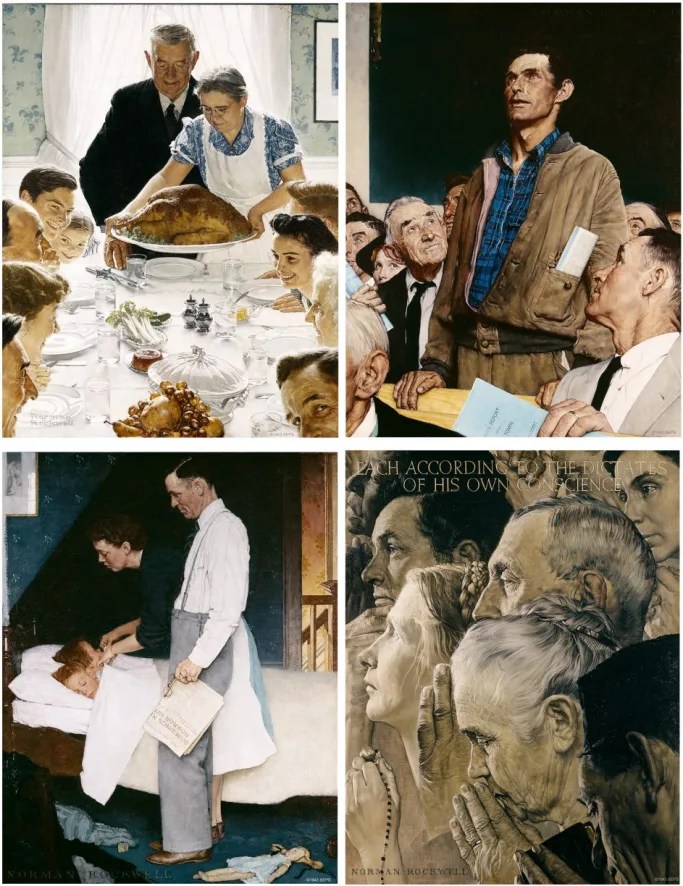
Which were the materialization in the American imagination of what President Franklin D. Roosevelt proposed on January 6, 1941, which went down in history as the 1941 State of the Union address and which should “contemplate all the people of the world”.
And what was happening to “all the people in the world”?
Before checking this, let’s look at the US domestic situation before involvement in World War II.
The State of the Union address before Congress was largely about the national security of the United States and the threat to other democracies from World War I that was raging on every continent in the Eastern Hemisphere. In the speech, he broke with the United States tradition of non-interventionism that had long existed in the United States. He highlighted the US role in helping allies already engaged in war
In this context, he summarized the values of democracy that were behind the bipartisan consensus on international engagement that existed at the time. The famous quote from the preface of this speech tells what these values are: “In the same way that men do not live by bread alone, they do not fight by weapon alone.” In the second half of the speech, he lists the benefits of democracy, which include opportunities economic, employment, social security, and the promise of “adequate health care.” The first two freedoms of speech and religion are protected by the First Amendment of the United States Constitution. Roosevelt’s inclusion of the latter two freedoms went beyond the traditional constitutional values protected by the U.S. Bill of Rights. Roosevelt endorsed a broader human right to economic security and anticipated what would come to be known decades later as the “human security” paradigm in social science and economic development. It also included “freedom from fear” against national aggression before the idea of a United Nations for this protection was conceived or discussed by world leaders and allied nations.
Historical Context of the Four Freedoms Speech
With the end of the First World War (1914-1918), the United States adopted a policy of isolationism and non-interventionism, having refused to approve the Treaty of Versailles (1919) or formally enter the League of Nations. Many Americans remembering the horrors of World War I and, believing that their involvement in World War I had been a mistake, were adamantly against continued intervention in European affairs. With the Neutrality Act established after 1935, US law prohibited the sale of weapons to countries that were at war and placed restrictions on travel with belligerent vessels.
When World War II began in 1939 with Germany’s invasion of Poland, the United States was still committed to its noninterventionist ideals. Although Roosevelt, and a large segment of the population, supported the Allied cause, neutrality laws and a strong isolationist element in Congress ensured that no substantial support could be given. With the revision of the Neutrality Act in 1939, Roosevelt adopted a “methods-short-of-war policy”, in which supplies and armaments could be provided to European allies, as long as there was no declaration of war and no troops were sent. In December 1940, Europe was largely at the mercy of Adolf Hitler and Germany’s Nazi regime. With the defeat of France by Germany in June 1940, Great Britain was practically alone against the military alliance of Germany, Italy and Japan. Winston Churchill, as Prime Minister of Great Britain, asked Roosevelt and the United States to provide them with weapons in order to continue their war effort.
What was the actual reality and what changes which ocurred to that reality?
Before particularize and focus in the contribution of Norman Rockwell art and the kind of reality it foresaw, let’s recall and understand what happened: (If you are american our educated in history, you can jump directly to Where Norman Rockwell art played a role):
“Methods short of war” in U.S. foreign policy during World War II refers to a range of strategies and actions employed by the United States to support Allied nations and oppose Axis powers without directly entering the conflict until the attack on Pearl Harbor in December 1941. The policies involved were:
Key Elements of “Methods Short of War”:
1. Economic Measures:
- Lend-Lease Act (1941): This critical policy allowed the U.S. to supply military aid to Allied nations, particularly the United Kingdom and the Soviet Union, without requiring immediate payment. The act enabled the transfer of arms, ammunition, and other supplies essential for the Allied war effort.
- Neutrality Acts: Initially, these acts aimed to prevent U.S. involvement in foreign conflicts by restricting arms sales and loans to belligerent nations. However, they were gradually modified to allow for greater support to Allies, particularly through the “cash and carry” provision that permitted belligerents to purchase arms from the U.S. as long as they paid cash and transported the goods themselves.
- Economic Sanctions and Embargoes: The U.S. imposed economic sanctions and embargoes on Axis powers, notably Japan, to restrict their access to vital resources such as oil and steel. These measures aimed to weaken the military capabilities of Axis nations without direct military confrontation.
Sources:
2. Diplomatic Efforts:
- Atlantic Charter (1941): A pivotal policy statement issued by President Franklin D. Roosevelt and British Prime Minister Winston Churchill that outlined the Allies’ goals for the post-war world, emphasizing self-determination, economic cooperation, and peace. The charter strengthened the U.S.-UK alliance and set the stage for broader international cooperation.
- Good Neighbor Policy: While primarily aimed at improving relations with Latin American countries, this policy also sought to secure hemispheric solidarity against Axis influence in the Americas.
Sources:
3. Limited Military Actions:
- Destroyers for Bases Agreement (1940): An agreement between the U.S. and the UK in which the U.S. provided 50 destroyers to Britain in exchange for leases on British bases in the Caribbean and Newfoundland. This deal bolstered British naval capabilities while enhancing U.S. strategic positioning.
- Patrolling the Atlantic: U.S. Navy ships began patrolling the Atlantic Ocean to monitor and report Axis submarine activity, providing critical intelligence to Allied forces.
- Support for China: The U.S. provided military aid and advisors to China to help resist Japanese aggression, reflecting a broader strategy to limit Axis expansion in the Asia-Pacific region.
Sources:
Conclusion
“Methods short of war” encapsulates the various strategies the U.S. employed to support Allied nations and undermine Axis powers while avoiding direct involvement in World War II until the Pearl Harbor attack. These methods included economic support through the Lend-Lease Act, diplomatic initiatives like the Atlantic Charter, and limited military engagements such as the Destroyers for Bases Agreement. These efforts helped shape the course of the war and laid the groundwork for the U.S.’s eventual full-scale entry into the conflict.
America goes to war
I transcribe it here from the National Museum of WW2 because eventually I will translate it to my mother language Portuguese and because it might disappear. This is what is under or behind the transformation of the United States of America the number one nation in the world. World War II and its aftermath can indeed be seen as the “final touch” or the “last drop” that solidified the United States’ rise to global dominance. While the foundations for this rise were already in place due to the country’s economic, industrial, and cultural strengths, the war and subsequent events accelerated and cemented its position as the leading global superpower. This period marked the transition from a strong, influential nation to the preeminent world leader in various domains. Let’s take a look in more detail how it initially evolved:
December 7, 1941: A Day That Will Live in Infamy
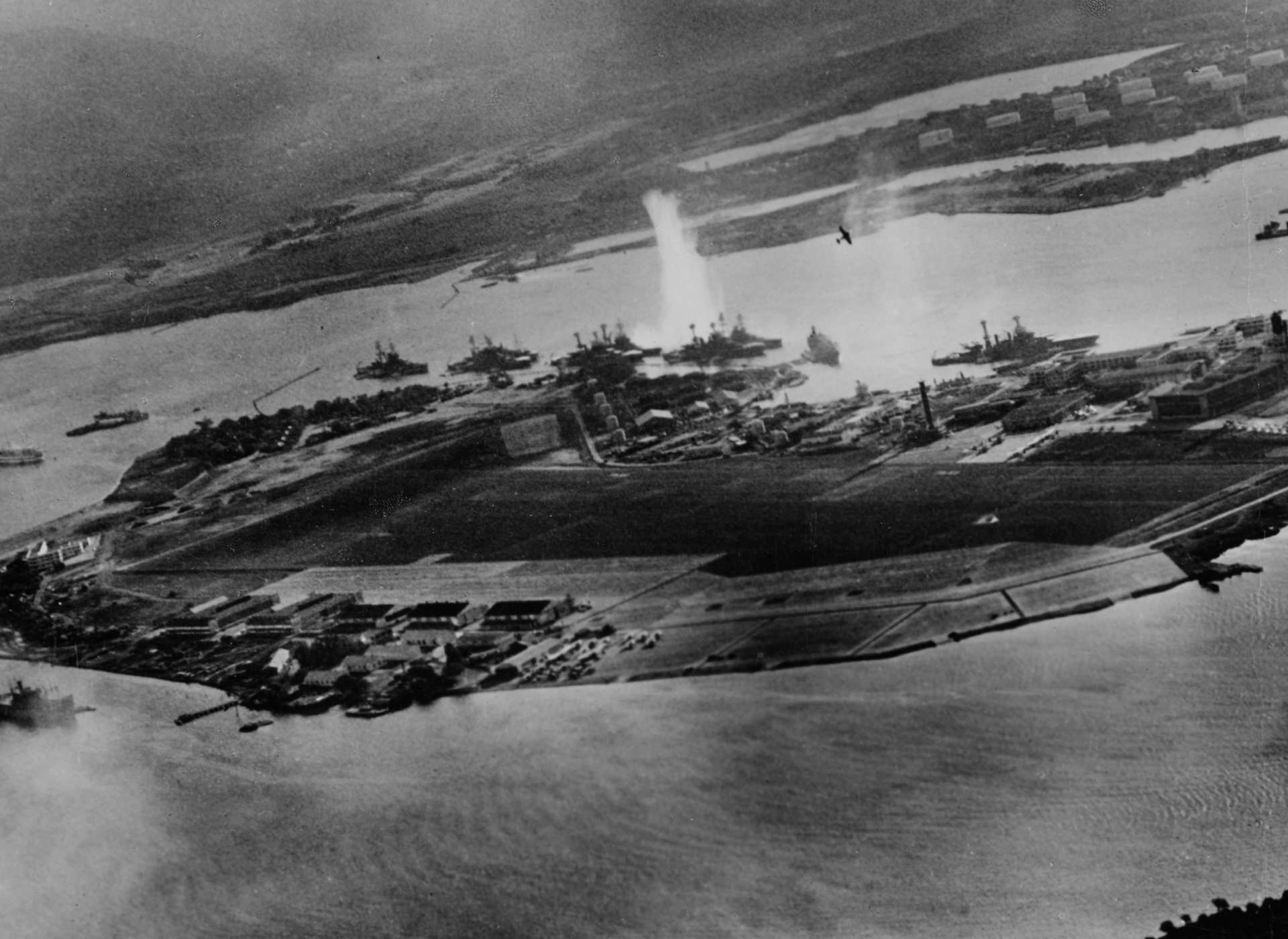
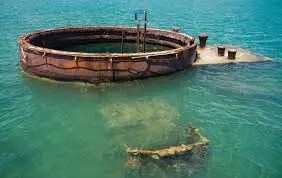
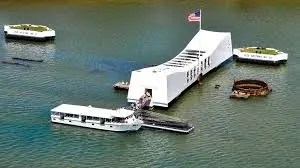
America’s isolation from war ended on December 7, 1941, when Japan staged a surprise attack on American military installations in the Pacific. The most devastating strike came at Pearl Harbor, the Hawaiian naval base where much of the US Pacific Fleet was moored. In a two-hour attack, Japanese warplanes sank or damaged 18 warships and destroyed 164 aircraft. Over 2,400 servicemen and civilians lost their lives.
America’s Reaction
“No matter how long it may take us to overcome this premeditated invasion, the American people in their righteous might will win through to absolute victory.”
— President Franklin D. Roosevelt, December 8, 1941
Though stunned by the events of December 7, Americans were also resolute. On December 8, President Roosevelt asked Congress to declare war against Japan. The declaration passed with just one dissenting vote. Three days later, Germany and Italy, allied with Japan, declared war on the United States. America was now drawn into a global war. It had allies in this fight–most importantly Great Britain and the Soviet Union. But the job the nation faced in December 1941 was formidable.
JOINING THE MILITARY
The United States faced a mammoth job in December 1941. Ill-equipped and wounded, the nation was at war with three formidable adversaries. It had to prepare to fight on two distant and very different fronts, Europe and the Pacific.
America needed to quickly raise, train, and outfit a vast military force. At the same time, it had to find a way to provide material aid to its hard-pressed allies in Great Britain and the Soviet Union.
Meeting these challenges would require massive government spending, conversion of existing industries to wartime production, construction of huge new factories, changes in consumption, and restrictions on many aspects of American life. Government, industry, and labor would need to cooperate. Contributions from all Americans, young and old, men and women, would be necessary to build up what President Roosevelt called the “Arsenal of Democracy.”
In the months after Pearl Harbor, the nation swiftly mobilized its human and material resources for war. The opportunities and sacrifices of wartime would change America in profound, and sometimes unexpected, ways.
Recruitment
The primary task facing America in 1941 was raising and training a credible military force. Concern over the threat of war had spurred President Roosevelt and Congress to approve the nation’s first peacetime military draft in September 1940. By December 1941 America’s military had grown to nearly 2.2 million soldiers, sailors, airmen, and marines.
America’s armed forces consisted largely of “citizen soldiers”,men and women drawn from civilian life. They came from every state in the nation and all economic and social strata. Many were volunteers, but the majority,roughly 10 million,entered the military through the draft. Most draftees were assigned to the army. The other services attracted enough volunteers at first, but eventually their ranks also included draftees.
Barracks Life
Upon their arrival at the training camps, inductees were stripped of the freedom and individuality they had enjoyed as civilians. They had to adapt to an entirely new way of living, one that involved routine inspections and strict military conduct, as well as rigorous physical and combat training. They were given identical haircuts, uniforms, and equipment, and were assigned to spartan barracks that afforded no privacy and little room for personal possessions.
The Draft
By late 1942 all men aged 18 to 64 were required to register for the draft, though in practice the system concentrated on men under 38. Eventually 36 million men registered. Individuals were selected from this manpower pool for examination by one of over 6,000 local draft boards. These boards, comprised of citizens from individual communities, determined if a man was fit to enter the military. They considered factors like the importance of a man’s occupation to the war effort, his health, and his family situation. Many men volunteered rather than wait to be drafted. That way, they could choose their branch of service.
Potential servicemen reported to military induction centers to undergo physical and psychiatric examinations. If a man passed these exams, he was fingerprinted and asked which type of service he preferred, though his assignment would be based on the military’s needs. After signing his induction papers, he was issued a serial number. The final step was the administration of the oath. He was now in the military. After a short furlough, he reported to a reception center before being shipped to a training camp. New recruits faced more medical examinations, inoculations, and aptitude tests.
Training
The training camp was the forge in which civilians began to become military men and women. In the training camps new servicemen and women underwent rigorous physical conditioning. They were drilled in the basic elements of military life and trained to work as part of a team. They learned to operate and maintain weapons. They took tests to determine their talents and were taught more specialized skills. Paratroopers, antiaircraft teams, desert troops, and other unique units received additional instruction at special training centers.
THE HOME FRONT
“I need not repeat the figures. The facts speak for themselves…. These men could not have been armed and equipped as they are had it not been for the miracle of production here at home. The production which has flowed from the country to all the battlefronts of the world has been due to the efforts of American business, American labor, and American farmers, working together as a patriotic team.”
–President Franklin D. Roosevelt, Navy Day speech, October 27, 1944
Raising an armed force was just part of America’s war effort. That force had to be supplied with the uniforms, guns, tanks, ships, warplanes, and other weapons and equipment needed to fight. With its vast human and material resources, the United States had the potential to supply both itself and its allies. But first the American economy had to be converted to war production.
The war production effort brought immense changes to American life. As millions of men and women entered the service and production boomed, unemployment virtually disappeared. The need for labor opened up new opportunities for women and African Americans and other minorities. Millions of Americans left home to take jobs in war plants that sprang up around the nation. Economic output skyrocketed.
The war effort on the “Home Front” required sacrifices and cooperation. “Don’t you know there’s a war on?” was a common expression. Rationing became part of everyday life. Americans learned to conserve vital resources. They lived with price controls, dealt with shortages of everything from nylons to housing, and volunteered for jobs ranging from air raid warden to Red Cross worker.
RATIONING AND RECYCLING
“Food for Victory”
To conserve and produce more food, a “Food for Victory” campaign was launched. Eating leftovers became a patriotic duty and civilians were urged to grow their own vegetables and fruits. Millions of “Victory gardens,” planted and maintained by ordinary citizens, appeared in backyards, vacant lots, and public parks. They produced over 1 billion tons of food. Americans canned food at home and consulted “Victory cookbooks” for recipes and tips to make the most of rationed goods.
“Make It Do or Do Without”
War production created shortages of critical supplies. To overcome these shortages, war planners searched for substitutes. One key metal in limited supply was copper. It was used in many war-related products, including assault wire. The military needed millions of miles of this wire to communicate on battlefields.
To satisfy the military’s demands, copper substitutes had to be found to use in products less important to the nation’s defense. The US Mint helped solve the copper shortage. During 1943 it made pennies out of steel. The Mint also conserved nickel, another important metal, by removing it from 5-cent coins. Substitutions like these helped win the production battle.
“Do With Less, So They’ll Have More”
The military needed more than guns and ammunition to do its job. It had to be fed. The Army’s standard K ration included chocolate bars, which were produced in huge numbers. Cocoa production was increased to make this possible.
Sugar was another ingredient in chocolate. It was also used in chewing gum, another part of the K ration. Sugar cane was needed to produce gunpowder, dynamite, and other chemical products.
To satisfy the military’s needs, sugar was rationed to civilians. The government also rationed other foods, including meat and coffee. Local rationing boards issued coupons to consumers that entitled them to a limited supply of rationed items.
“Save Waste Fat for Explosives”
Ammunition for rifles, artillery, mortars, and other weapons was one of the most important manufacturing priorities of World War II. A key ingredient needed to make the explosives in much ammunition was glycerine.
To help produce more ammunition, Americans were encouraged to save household waste fat, which was used to make glycerine. Other household goods,including rags, paper, silk, and string,were also recycled. This was a home front project that all Americans could join.
SALVAGE FOR VICTORY
Canteens are a standard part of military equipment. Millions were produced during the war. Most were made of steel or aluminum, metals which were also used to make everything from ammunition to ships. At times, both metals were in short supply.
To meet America’s metal needs, scrap was salvaged from basements, backyards, and attics. Old cars, bed frames, radiators, pots, and pipes were just some of the items gathered at metal “scrap drives” around the nation. Americans also collected rubber, tin, nylon, and paper at salvage drives.
“Share Your Cars and Spare Your Tires”
America’s military needed millions of tires for jeeps, trucks, and other vehicles. Tires required rubber. Rubber was also used to produce tanks and planes. But when Japan invaded Southeast Asia, the United States was cut off from one of its chief sources of this critical raw product.
America overcame its rubber shortage in several ways. Speed limits and gas rationing forced people to limit their driving. This reduced wear and tear on tires. A synthetic rubber industry was created. The public also carpooled and contributed rubber scrap for recycling.
Dollars for Defense
To help pay for the war, the government increased corporate and personal income taxes. The federal income tax entered the lives of many Americans. In 1939 fewer than 8 million people filed individual income tax returns. In 1945 nearly 50 million filed. The withholding system of payroll deductions was another wartime development. The government also borrowed money by selling “war bonds” to the public. With consumer goods in short supply, Americans put much of their money into bonds and savings accounts.
MOBILIZING THE ECONOMY
America’s economy performed astonishing feats during World War II. Manufacturers retooled their plants to produce war goods. But this alone was not enough. Soon huge new factories, built with government and private funds, appeared around the nation. Millions of new jobs were created and millions of Americans moved to new communities to fill them. Annual economic production, as measured by the Gross National Product (GNP), more than doubled, rising from $99.7 billion in 1940 to nearly $212 billion in 1945.
Production Miracles In industry after industry Americans performed production miracles. One story helps capture the scale of the defense effort. In 1940 President Roosevelt shocked Congress when he proposed building 50,000 aircraft a year. In 1944 the nation made almost double that number. Ford’s massive Willow Run bomber factory alone produced nearly one plane an hour by March 1944.
To achieve increases like this, defense spending jumped from $1.5 billion in 1940 to $81.5 billion in 1945. By 1944 America led the world in arms production, making more than enough to fill its military needs. At the same time, the United States was providing its allies in Great Britain and the Soviet Union with critically needed supplies.
Civilian Defense
Many Americans volunteered to defend the nation from enemy bombing or invasion. They trained in first aid, aircraft spotting, bomb removal, and fire fighting. Air raid wardens led practice drills, including blackouts. By mid-1942 over 10 million Americans were civil defense volunteers.
Though America’s mainland was never invaded, there were dangers offshore. Several Japanese submarines were spotted near the Pacific coast, and German U-boats patrolled the Atlantic coast, the Gulf of Mexico, and the Caribbean Sea. At least 10 US naval vessels were sunk or damaged by U-boats operating in American waters.
A Workforce Changed by War: Unemployment Disappears
The war virtually ended unemployment in America. The need for workers led manufacturers to hire women, teenagers, the aged, and minorities previously excluded by discrimination from sectors of the economy. Plentiful overtime work contributed to rising wages and increased savings.
Military and economic expansion created labor shortages. To fill the gap, government and industry encouraged women to enter the workforce. Though most working women continued to labor in more traditional employment like waitressing and teaching, millions took better-paid jobs in defense factories.
African Americans and other minorities also took high-paying industrial jobs previously reserved for whites. In 1941, black labor leader A. Philip Randolph threatened to organize a protest march on Washington, D.C. if the government didn’t bar racial discrimination in defense plants with government contracts. Faced with this threat, President Roosevelt banned such discrimination and created the Fair Employment Practices Commission (FEPC) to investigate bias charges.
Millions of women, including many mothers, entered the industrial workforce during the war. They found jobs in especially large numbers in the shipbuilding and aircraft industries. “Rosie the Riveter” became a popular symbol of patriotic womanhood. Though defense jobs paid far more than traditional “female” occupations, women were still often paid less than men performing comparable work. Moreover, at war’s end, women were expected to leave the factories to make way for returning male veterans.
HIGGINS BOATS
Higgins Industries designed and built two basic classes of military craft.
The first was landing craft, constructed of wood and steel and used to transport fully armed troops, light tanks, field artillery, and other mechanized equipment and supplies to shore. These boats helped make the amphibious landings of World War II possible.
Higgins also designed and manufactured supply vessels and specialized patrol craft, including high-speed PT boats, antisubmarine boats, and dispatch boats.
LCVP (Landing Craft, Vehicle, Personnel)
The LCVP was the most famous landing craft designed and produced by Higgins Industries. It could land soldiers, and even jeeps, on a beach. LCVPs were used in North Africa, Europe, and the Pacific during the war.
From the Eureka…
The LCVP (Landing Craft, Vehicle, Personnel), the best-known landing craft designed by Andrew Higgins, evolved from a boat he created before the war for use in the swamps and marshes of Louisiana. Trappers and oil companies needed a rugged, shallow-bottomed craft that could navigate these waters, run aground, and retract itself without damaging its hull. Higgins developed a boat that could perform all these tasks: a spoonbill-bowed craft he called the Eureka. Over time he modified and improved his craft and found markets for it in the United States and abroad.
…to the LCP(L)
During the 1930s Higgins tried to interest the U.S. Navy in adapting his shallow-draft Eureka for use as an amphibious landing craft. The navy showed little interest, but Higgins persisted. After a long struggle, he finally secured a government contract to build modified Eurekas for military use. The new boat was called the LCP (Landing Craft, Personnel) and, later, the LCP(L) (Landing Craft, Personnel, Large). In its most advanced form the LCP(L) measured 36 feet in length. It could transport men from ships offshore directly onto a beach, then retract itself, turn, and head back to sea.
The LCVP (Landing Craft, Vehicle, Personnel) was developed because the U.S. Marines needed a boat capable of transporting vehicles to shore. Higgins adapted the LCP(L) to meet this requirement. He replaced the LCP(L)’s rounded bow with a retractable ramp. The new craft was tested for the first time on May 26, 1941, on Lake Pontchartrain. It carried a truck and 36 Higgins employees safely to shore. The LCVP became the military’s standard vehicle and personnel landing craft. Thousands were in service during the war.
New Orleans” Home of the Higgins Boats
“If Higgins had not designed and built those LCVPs, we never could have landed over an open beach. The whole strategy of the war would have been different.”
–General Dwight D. Eisenhower
The city of New Orleans made a unique and crucial contribution to America’s war effort. This was the home of Higgins Industries, a small boat company owned by a flamboyant entrepreneur named Andrew Jackson Higgins. The story of Higgins’ role in the war is little known today, but his contribution to the Allied victory was immeasurable.
World War II presented Allied war planners with a tactical dilemma–how to make large amphibious landings of armies against defended coasts. For America this was a particularly thorny problem, since its armed forces had to mount amphibious invasions at sites ranging from Pacific atolls to North Africa to the coast of France.
Higgins’ contribution was to design and mass-produce boats that could ferry soldiers, jeeps, and even tanks from a ship at sea directly onto beaches. Such craft gave Allied planners greater flexibility. They no longer needed to attack heavily defended ports before landing an assault force. Higgins’ boats were used in every major American amphibious operation of World War II. His achievements earned him many accolades. The greatest came from General Dwight D. Eisenhower, who called Higgins “the man who won the war for us.”
From the Bayou to the Battlefront
Before World War II Andrew Higgins operated a small boatyard, building workboats designed to operate in the shallow waters of Louisiana’s bayous. During the 1920s and 1930s America’s military began exploring ways to make amphibious landings. Higgins became involved in this effort, adapting designs for shallow-draft boats he had developed for peacetime uses. His company created amphibious assault craft capable of shuttling men and equipment quickly and safely from ship to shore. When the war came, business boomed. Higgins built new factories with mass production lines and employed thousands of workers. He even opened a training school for boat operators.
New Orleans Naval Giant During World War II Higgins Industries grew from a small business operating a single boatyard into the largest private employer in Louisiana. The company turned out astounding numbers of boats and ships. In September 1943 the US Navy had 14,072 vessels. Of these, 8,865 had been designed and built by Higgins Industries.
Where Norman Rockwell art played a role
The Four Freedoms speech delivered on January 6, 1941
Roosevelt’s hope was to provide a justification for why the United States should abandon the isolationist policies that emerged from World War I. The speech coincided with the introduction of the Lend-Lease Bill, which furthered Roosevelt’s plan to become the “arsenal of democracy” and support the allies (primarily the British) with much needed supplies necessary. Furthermore, the speech established what would become the ideological basis for United States involvement in World War II, all framed in terms of the individual rights and freedoms that are the hallmark of American politics.
Lend Lease Act
This bill authorized the president to “sell, transfer title to, exchange, lease, lend, or otherwise dispose of, to any government (the defense of which the President deems vital to the defense of the United States) any article of defense.” In effect, it allowed Pres. Roosevelt authorized the transfer of military materials to Great Britain with the understanding that they would someday be repaid or returned if they were not destroyed. To administer the program, Roosevelt created the Office of Lend-Lease Administration under the leadership of former steel industry executive Edward R. Stettinius.
To sell the idea of the program to a skeptical and still somewhat isolationist American public, Roosevelt likened it to lending the hose to a neighbor whose house was on fire. “What do I do in a crisis like this?” the president asked the press. “I don’t say… ‘Neighbor, my garden hose costs me $15, you have to pay me $15 for it’ – I don’t want $15 – I want my garden hose back after the fire is over .” In April, he expanded the program, offering Lend-Lease aid to China in its war against the Japanese. Quickly taking advantage of the program, the British received over $1 billion in aid by October 1941.
The speech given by President Roosevelt incorporated the following
“In the future, the days we seek to make safe today, we do so by looking forward to a world founded on four essential human freedoms. The first is freedom of opinion and expression – everywhere in the world. The second is the freedom of each person to worship God in his own way – everywhere in the world. The third is freedom from want, which, translated into global terms, means economic understandings that can guarantee each nation a life of healthy peace for its inhabitants – everywhere in the world. The fourth is freedom from fear, which, translated into global terms, means a worldwide reduction of armaments to such an extent and so completely that no nation will be in a position to commit an act of physical aggression against any neighbor – anywhere of the world. This is not a vision from a distant millennium. It is a definitive basis for a kind of possible world in our own time and generation. This type of world is the very antithesis of the so-called new order of tyranny that dictators seek to create as if they were throwing a bomb. “-Franklin D. Roosevelt, excerpted from the State of the Union Address to Congress, January 6, 1941.
The flag of the four freedoms or “United Nations Honor Flag” ca. 1943-1948

The declaration of the four freedoms as a justification for the war would resonate throughout the duration of the war and for decades to come, more as a framework to remember. The four freedoms became the main binder of America’s war aims and the core of all attempts to gain public support for the war. With the creation of the Office of War Information (1942), as well as Norman Rockwell’s famous paintings, the four freedoms were heralded as values central to life and examples of American exceptionalism. This did not occur in a logical sequence as later suggested, as the government rejected Norman Rockwell’s offer, but as the paintings had the effect of making the public understand and became popular, they were incorporated.
Initial rejection of Norman Rockwell’s depiction of the four freedoms:
This twist that looked from today’s perspective seems absurd is an excellent example how thing happen in reality when dealing with human affairs and deserves a detailed account:
The four freedoms speech was a great success and these objectives would be central to the development of post-war human rights policy. However, in 1941 the speech received strong criticism from isolationists and many conservatives in Congress. Critics argued that the four freedoms were simply a charter for Roosevelt’s New Deal, social reforms that had already created deep divisions within Congress. Conservatives who opposed social programs and increased government intervention argued against Roosevelt’s attempt to justify and use the war as necessary to defend liberal policies.
While Liberties became a force in American thinking about war, it was never the exclusive justification for war. Research and surveys conducted by the Office of War Information (OWI) revealed that “self-defense” of American values, and revenge for Pearl Harbor were the most common reasons for war. Although Roosevelt sought to use the four freedoms as a counter ideology to fascism and as a force to mobilize an apathetic nation for war in Europe, the record indicates that Americans were more concerned with their own personal experience than with liberal humanitarianism.
Rockwell approached the Office of War Information (OWI) with his idea to use the paintings as part of the government’s war effort, hoping they would help promote the ideals for which the U.S. was fighting. The Office of War Information OWI initially rejected Rockwell’s paintings, feeling that his approach was too folksy and traditional for the government’s purposes. They were looking for more modern and abstract forms of propaganda to mobilize public support for the war.
Undeterred by the government’s rejection, Rockwell turned to The Saturday Evening Post, then a widely read magazine where he regularly contributedk and The Four Freedoms series was published in four consecutive issues in 1943, accompanied by essays from contemporary writers.
Freedom of Worship
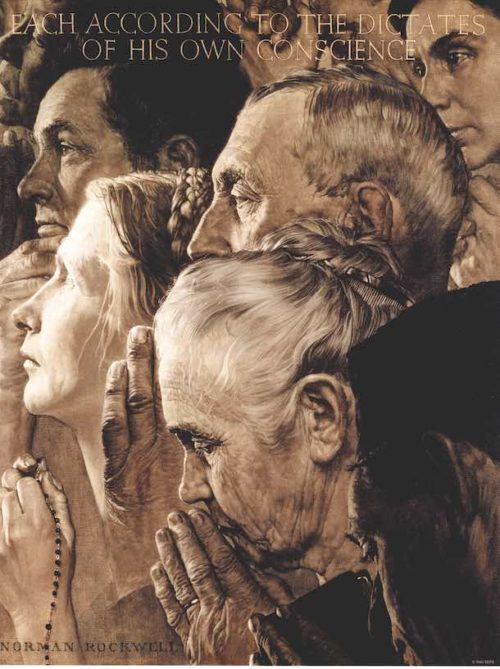
You can read it in full, but here are some excerpts:
Why are we religious?
Man differs from the animal in two things: He laughs, and he prays. Perhaps the animal laughs when he plays, and prays when he begs or mourns; we shall never know any soul but our own, and never that. But the mark of man is that he beats his head against the riddle of life, knows his infinite weakness of body and mind, lifts up his heart to a hidden presence and power, and finds in his faith a beacon of heartening hope, a pillar of strength for his fragile decency.
Religion like music lives in a world beyond words or thoughts or things. These experiences feel the mystery of consciousness within themselves, and will not say that they are machines. These experiences reveal the growth of the soil and the child, they inhabit the fear and reverence of the swelling of the fields, in the hum that permeates the forest, and they perceive in each cell and atom the same creative power that springs from their own effort and achievement. Their impassive faces hide silent gratitude for the arrival of summer, the deadly beauty of autumn, and the joyful resurrection of spring. They have patiently watched the movement of the stars, and find them in a majestic order so harmoniously regular that our ears would bear their music if it were not eternal. Their weary eyes have known the ineffable splendor of earth and sky, even in storm, terror and destruction, and have never doubted that in this beauty there is some sense and meaning. They saw death, and looked beyond it with their hope
Based on this intuition and anticipating a time when many would say they were “spiritual but not religious” Durant offers the following:
And so they worship. The poetry of their ritual redeems the prose of their daily toil; the prayers they pray are secret summonses to their better selves; the songs they sing are shouts of joy in their refreshened strength. The commandments they receive, through which they can live with one another in order and peace, come to them as the imperatives of an inescapable deity, not as the edicts of questionable men. Through these commands they are made part of a divine drama, and their harassed lives take on a scope and dignity that cannot be canceled out by death.
Freedom from fear
Read it in full. Here some excerpts:
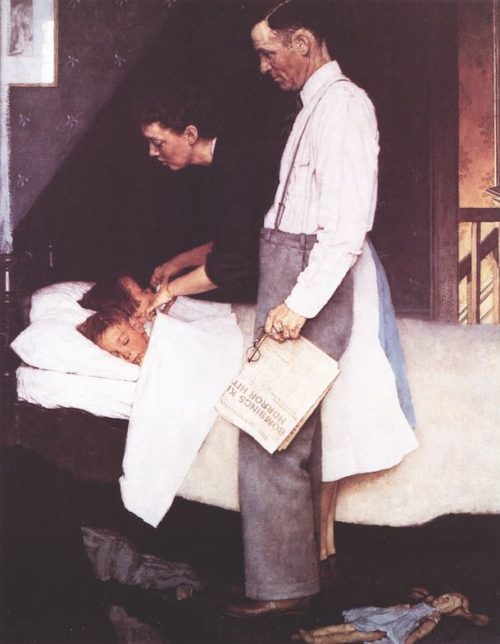
What do we mean when we say “freedom from fear”? It isn’t just a formula or a set of words. It’s a look in the eyes and a feeling in the heart and a thing to be won against odds. It goes to the roots of life — to a man and a woman and their children and the home they can make and keep.
Fear has walked at man’s heels through many ages — fear of wild beasts and wilder nature, fear of the inexplicable gods of thunder and lightning, fear of his neighbor man.
He saw his rooftree burned with fire from heaven — and did not know why. He saw his children die of plague — and did not know why. He saw them starve, he saw them made slaves. It happened — he did not know why. Those things had always happened.
Since our nation began, men and women have come here for just that freedom — freedom from the fear that lies at the heart of every unjust law, of every tyrannical exercise of power by one man over another man. They came from every stock — the men who had seen the face of tyranny, the men who wanted room to breathe and a chance to be men. And the cranks and the starry-eyed came, too, to build Zion and New Harmony and Americanopolis and the states and cities that perished before they lived — the valuable cranks who push the world ahead an inch. And a lot of it never happened, but we did make a free nation.
It is not enough to say, “Here, in our country, we are strong. Let the rest of the world sink or swim. We can take care of ourselves.” That may have been true at one time, but it is no longer true. We are not an island in space, but a continent in the world. While the air is the air, a bomb can kill your children and mine. Fear and ignorance a thousand miles away may spread pestilence in our own town. A war between nations on the other side of the globe may endanger all we love and cherish.
We who are alive today did not make our free institutions. We got them from the men of the past, and we hold them in trust for the future. Should we put ease and selfishness above them, that trust will fail and we shall lose all, not a portion or a degree of liberty, but all that has been built for us and all that we hope to build. Real peace will not be won with one victory. It can be won only by long determination, firm resolve, and a wish to share and work with other men, no matter what their race or creed or condition. And yet, we do have the choice. We can have freedom from fear.
Here is a house, a woman, a man, their children. They are not free from life and the obligations of life. But they can be free from fear. All over the world, they can be free from fear. And we know they are not yet free.
Freedom of Speech
Read in full. Some excerpts
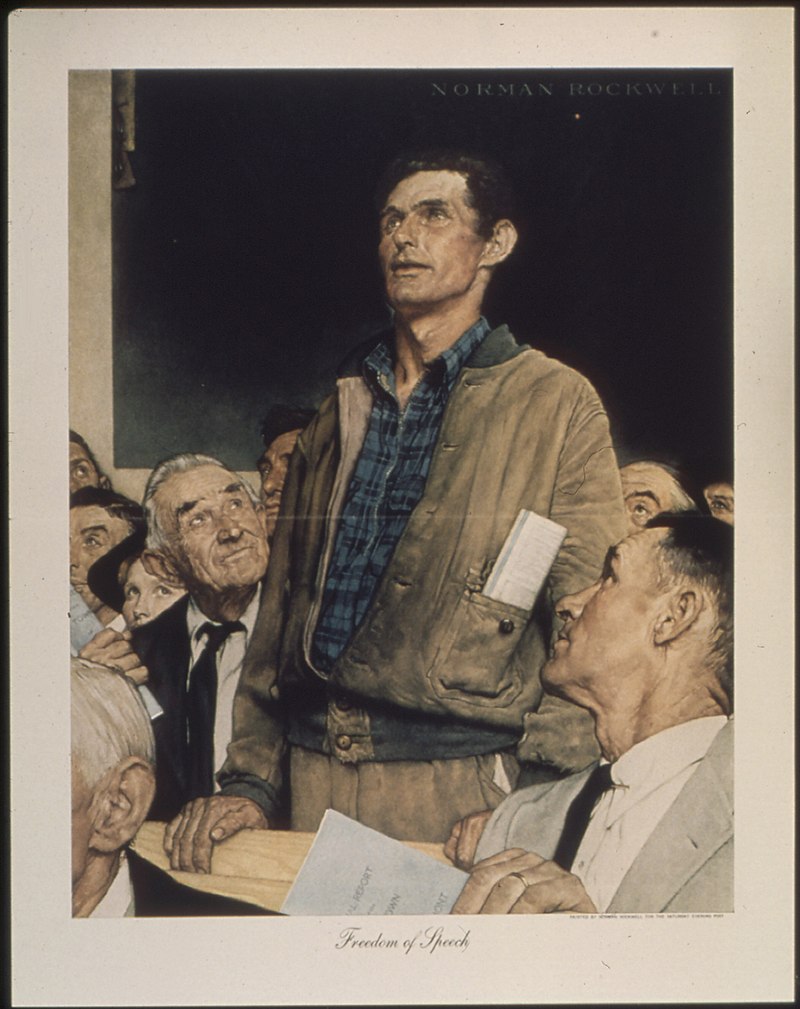
In a small chalet on the mountain road from Verona to Innsbruck, two furtive tourists sat, pretending not to study each other. Outdoors, the great hills rose in peace that summer evening in 1912; indoors, the two remaining patrons, both young, both dusty from the road, sat across the room from each other, each supping at his own small table.
Actually they are Adolf Hitler, then a painter and Benito Mussolini, then a journalist.
The text shrewdly introduces their personalities, but perhaps a summary was that:
“Greatness is easily mistaken for insanity,” the swarthy young man said. “Greatness is the ability to reduce the most intricate facts to simple terms. For instance, take fighting. Success is obtained by putting your enemy off his guard, then striking him where he is weakest — in the back, if possible. War is as simple as that.”
“Yes, and so is politics,” the painter assented absently as he ate some of the fruit that formed his supper. “Our mutual understanding of greatness helps to show that we are not lunatics, but only a simple matter of geography is needed to prove our sanity.”
“Geography?” The journalist didn’t follow this thought. “How so?”
“Imagine a map.” The painter ate a grape. “Put yourself in England, for instance, and put me and my dazzling ideas into that polyglot zoo, the United States of America. You in England can bellow attacks on the government till you wear out your larynx, and some people will agree with you and some won’t, and that is all that would happen. In America I could do the same. Do you not agree?”
“Certainly,” the journalist said. “In those countries the people create their own governments. They make them what they please, and so the people really are the governments. They let anybody stand up and say what he thinks. If they believe he’s said something sensible, they vote to do what he suggests. If they think he is foolish, they vote no. Those countries are poor fields for such as you and me, because why conspire in a wine cellar to change laws that permit themselves to be changed openly?”
“Exactly.” The watercolor painter smiled his faint strange smile. “Speech is the expression of thought and will. Therefore, freedom of speech means freedom of the people. If you prevent them from expressing their will in speech, you have them enchained, an absolute monarchy. Of course, nowadays he who chains the people is called a dictator.”
Freedom From Want
Read in full. Some excerpts:
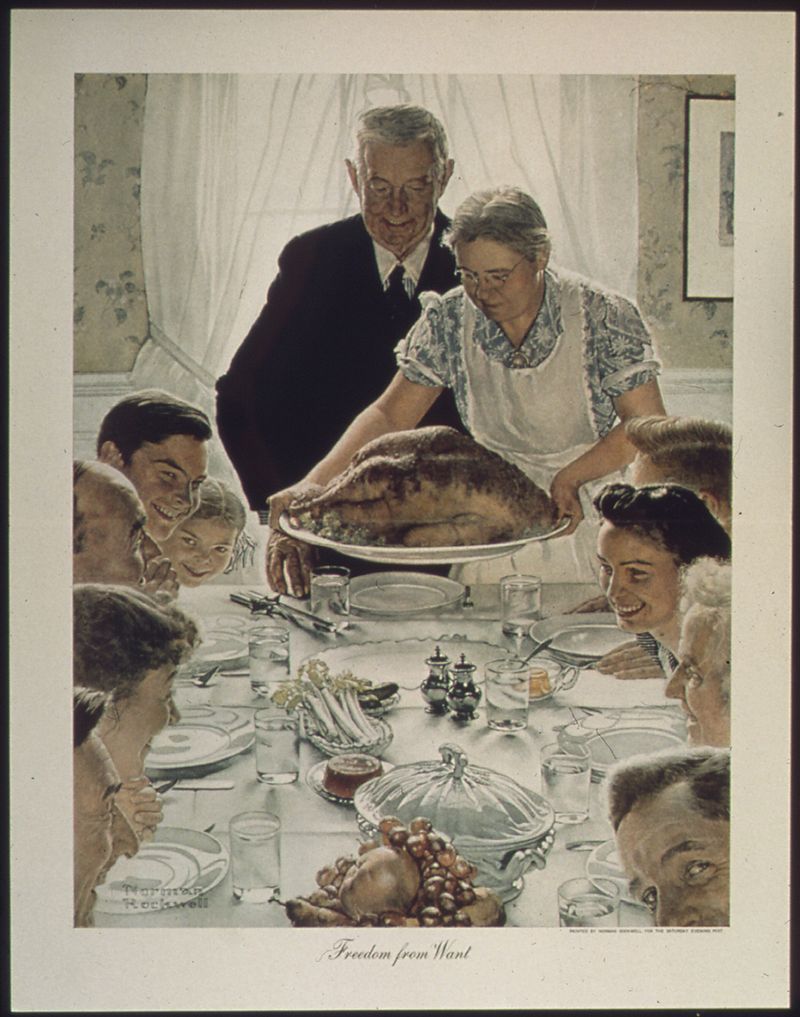
We march on, though sometimes strange moods fill our children. Our march toward security and peace is the march of freedom — the freedom that we should like to become a living part of. It is the dignity of the individual to live in a society of free men, where the spirit of understanding and belief exist; of understanding that all men are equal; that all men, whatever their color, race, religion or estate, should be given equal opportunity to serve themselves and each other according to their needs and abilities.
But we are not really free unless we use what we produce. So long as the fruit of our labor is denied us, so long will want manifest itself in a world of slaves. It is only when we have plenty to eat — plenty of everything — that we begin to understand what freedom means. To us, freedom is not an intangible thing. When we have enough to eat, then we are healthy enough to enjoy what we eat. Then we have the time and ability to read and think and discuss things. Then we are not merely living but also becoming a creative part of life. It is only then that we become a growing part of democracy.
Outcome
Before we finalize that with other contributions of Norman Rockwell to the war effort, let´s see how all that strategy led to the victory of the Allies and the end of WW2:
Eleven months after this publication, on December 8, 1941, the USA declared war on Japan, one day after the attack on Pear Harbor which was, in my opinion, the most significant event of the 20th century. Three days later, on December 11, Germany and Italy declared war on the United States.
The atomic bomb was dropped on Hiroshima on August 6, 1945 and on Nagasaki on August 9.
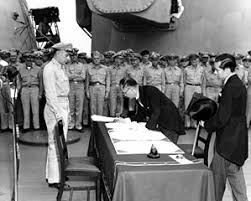
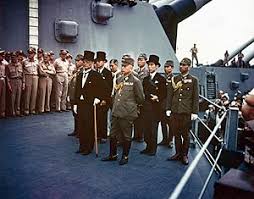
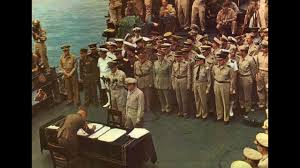
Japan surrendered unconditionally (it had never lost a war) on September 2nd (after announcing this on August 15th).
Mussolini was executed on April 28th, Hitler committed suicide on the 30th of the same month.
Germany surrendered little by little, through the commanders in chief, who each negotiated separately.
On May 1st in Italy, on May 2nd in Berlin, on May 4th in Northern Germany, Denmark and the Netherlands and also in Bavaria and Central Europe.
Goring, second in chief to Hitler, surrendered on the 6th.
On the same day, the 6th, the fortress city of Breslau, surrounded by the Russians, surrendered to them. On the 6th and 8th the forces that were in the Channel Islands surrendered to what Churchill announced in a radio address at 15:00 on the same day that “Hostilities will officially cease one minute after midnight today.”
Jodl and Keitel surrendered unconditionally on behalf of all German forces thirty minutes after the fall of the Breslau fortress, signing on the morning of May 7th their unconditional surrender to the Americans, repeating the same to the Russians on the 8th.
The 8th was V day for the Americans, but as it was the 9th in Russia, they celebrate the end of the war on this date.
The division of Germany into 4 parts, governed by the Americans, Russians, England (UK) and France, was signed on June 5th.
Truman would announce the cessation of hostilities between the US and Germany on December 13, 1946.
The peace treaty between the allies and the axis countries was signed on February 10, 1947. The Federal Republic of Germany was founded on May 23, 1949, its first government formed on September 20 of the same year. On November 22, the war allies formally declared the end of the state of war with Germany on November 22, 1949. The full authority of a sovereign state was granted on May 5, 1955, with special powers for England, USA and Russia, which would disappear completely on March 15, 1991.
In Japan it was a little different and it’s worth a word.
They had never lost a war, as I said, and surrendering was shameful and cowardly, as the Samurai code embedded in military culture decidedly rejected the idea of surrender, with the implication being that the defeated were at the mercy of the victorious and they themselves never demonstrated mercy towards their vanquished, and the way they raped, plundered and plundered, including enslaving the people they dominated, was famous.
They imagined they would suffer the same thing, made worse by the fact that they have a culture of committing suicide if they don’t get their way, which indicated serious problems for the allies in how to resolve all this. This was what was behind why they didn’t want to surrender. For us it is impossible to imagine what they felt (or feel) for the emperor, who is the human embodiment of the Japanese nation, its culture and civilization and for whom they were willing to die, perhaps in a collective suicide.
In other words, if the emperor ceased to exist, Japan would cease with it.
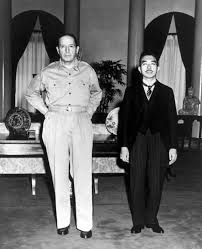
In a rare moment of common sense, the Americans understood this, or perhaps they had already understood this in another rare moment of madness, perhaps the greatest of all that a human being can have, when dropping the bombs, and President Truman guaranteed in writing that the Japan would not be enslaved, the emperor would continue to reign, under the authority of the allied command, General MacArthur. In view of this, they finally surrendered unconditionally and the document that I transcribe below was signed.
A curious thing about this document, which reveals a lot about nature and the human nature, is that the copy in Japan’s possession and the one in the USA differ in the following:
The allies’ copy was presented in leather with gold lining and with stamps from both countries printed on the front. The Japanese copy was made on rough canvas without stamps on the front. The Canadian Representative (who was blind in one eye) signed below rather than above the line and created a problem where everyone signed on the wrong line to the one intended for them and the Japanese objected. When the discrepancy was pointed out to General Sutherland, (MacArthur’s chief of staff) he crossed out the pre-printed names of the Allied nations and rewrote the titles by hand in their correct relative positions. This change was initially not accepted by the Japanese, whereupon Sutherland then initialed each change (with an abbreviated signature). Faced with this, the Japanese representatives did not object any further.
Japan was occupied for the first time in its history and was transformed into a democracy and somehow followed the model of President Roosevelt’s New Deal.
On September 8, 1951, the occupation ended, which officially ended on April 28, 1952, when Japan once again became an independent country, except for the Ryuku Islands.
Japan would be divided as Germany was, and it is historically unclear why this did not occur. Apparently, it was Truman who accomplished this.
Russia got North Korea and the Kuril Islands.
The US took South Korea, Okinawa, the Amami Islands, the Ogasawara Islands, and the Japanese possessions of Micronesia. China got Taiwan and Penghu.
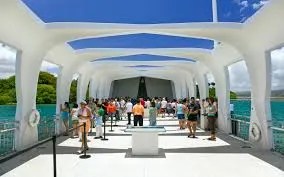
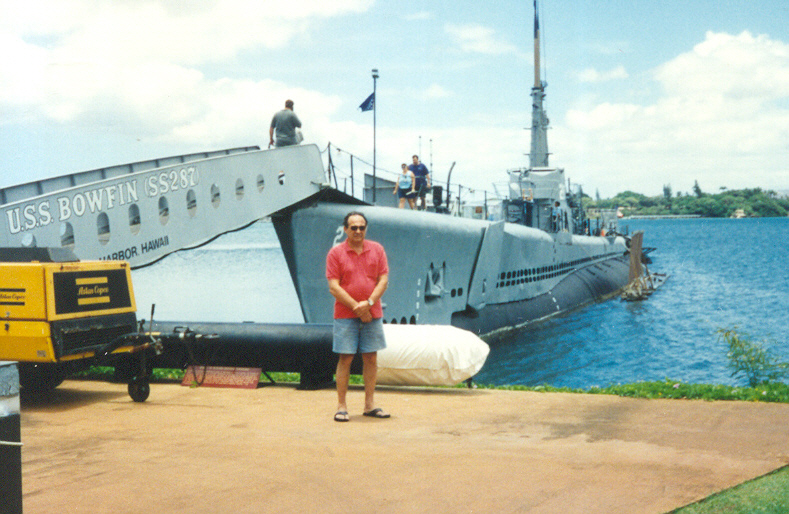
Pearl Harbour nowadays (1995)
Other contributions of Norman Rockwell to the war effort
Norman Rockwell’s contributions to the war effort through his art extended beyond the Four Freedoms. His works captured the spirit of the American people during a challenging time, promoting patriotism, resilience, and the importance of supporting the war effort both on the home front and abroad. These paintings and magazine covers remain iconic representations of World War II and the collective American experience during that period.
War Effort Paintings and Magazine Covers by Norman Rockwell
1. Rosie the Riveter (1943)
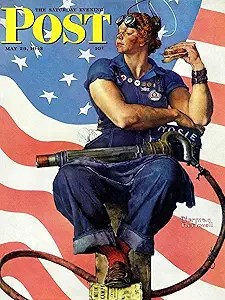
- Description: Depicts a strong, confident woman taking a lunch break with a riveting gun in her lap and her foot on a copy of Hitler’s Mein Kampf. This painting became an iconic representation of the women who worked in factories during the war.
- Published: The Saturday Evening Post, May 29, 1943
2. The Homecoming (1945)
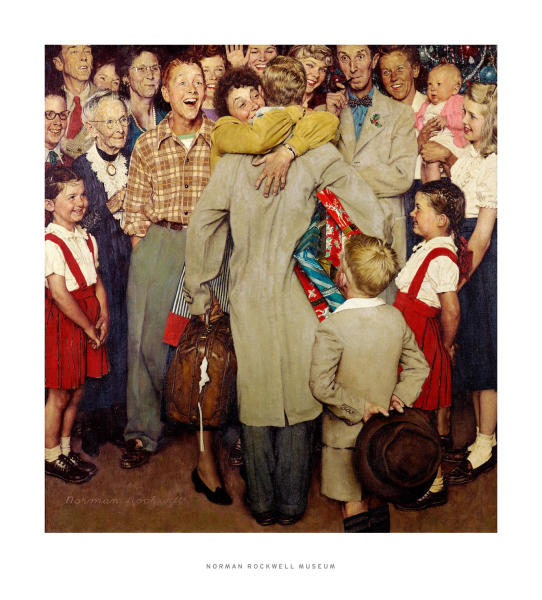
- Description: Shows a soldier returning home and being warmly greeted by his family and neighbors, capturing the joy and relief of the war’s end.
- Published: The Saturday Evening Post, May 26, 1945
3. Liberty Girl (1943)
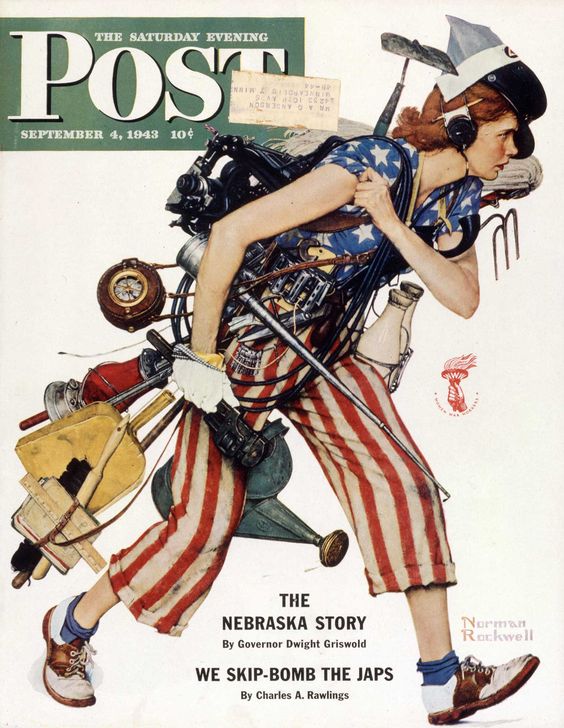
- Description: Features a patriotic young woman dressed in red, white, and blue, surrounded by symbols of American industry and war effort, such as tools and factory machinery.
- Published: The Saturday Evening Post, September 4, 1943
4. Potato Peeler. (1942)
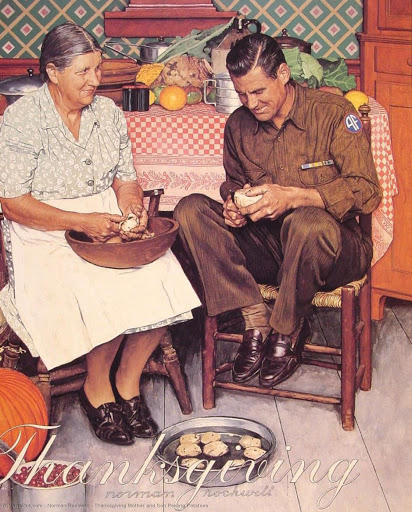
- Description: The painting depicts a U.S. Army private sitting on a crate and peeling potatoes with a knife. The soldier appears cheerful and content, suggesting a sense of duty and normalcy even in mundane tasks. This painting highlights the everyday life of soldiers and the importance of even the most routine tasks in the war effort.
- Published: The Saturday Evening Post, August 15, 1942.
5. Let’s Give Him Enough and On Time (1942)
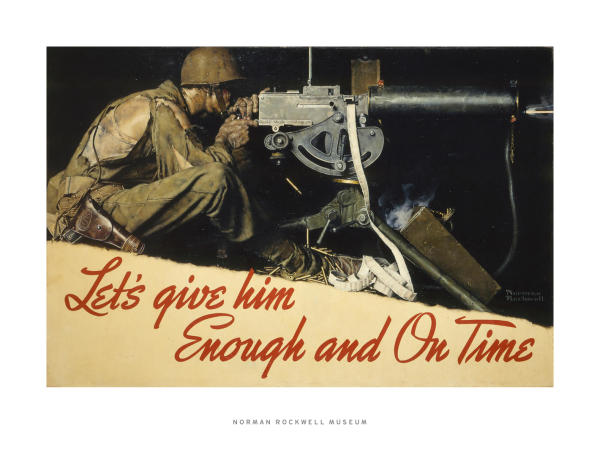
- Description: Part of a series of posters encouraging increased production and efficiency in war industries.
- Commissioned by: The War Production Board
6. “War Bond” (1944)
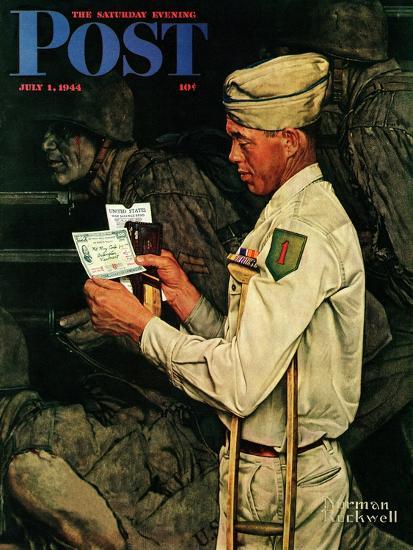
- Description: Shows a soldier participating in Christmas festivities, emphasizing the importance of morale and holiday spirit during wartime.
- Published: Saturday Evening Post Cover, July,1944
7. War Bonds Posters (1941-1945)
- Description: Rockwell created several posters encouraging Americans to buy war bonds to support the war effort financially. These posters often featured patriotic themes and imagery.
8. A Family Tree (1943)
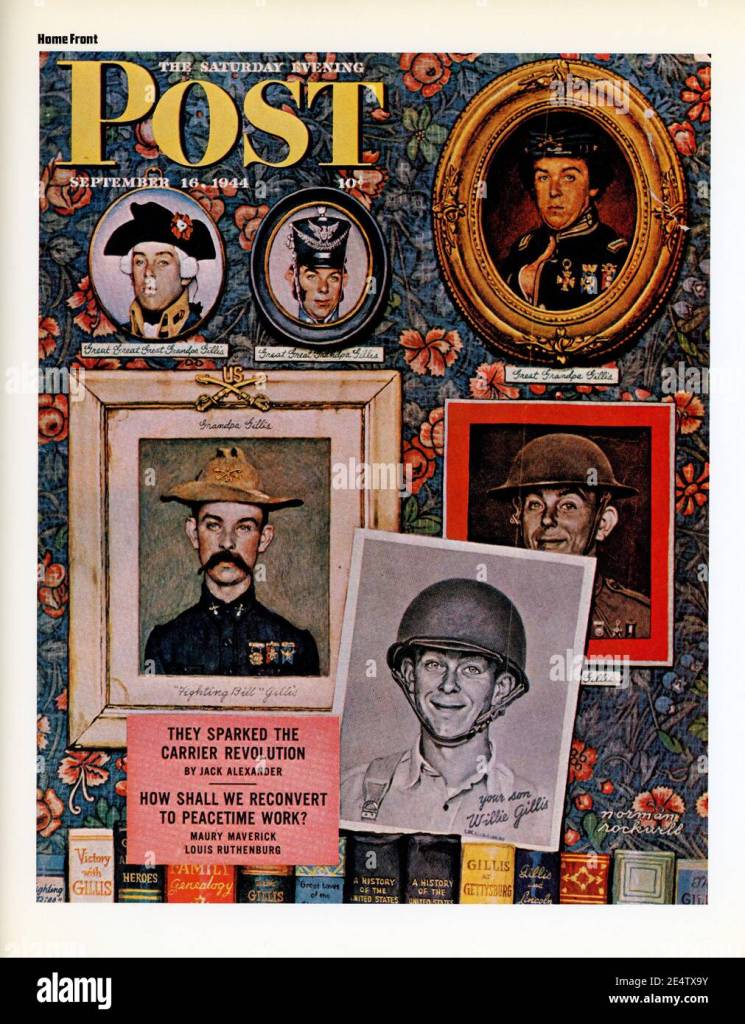
- Description: Illustrates a genealogical tree showing the descendants of a POW Norman Rockwell created for ilustrative purposes
- Published: The Saturday Evening Post, September 16, 1944
9. Family tree (1942)
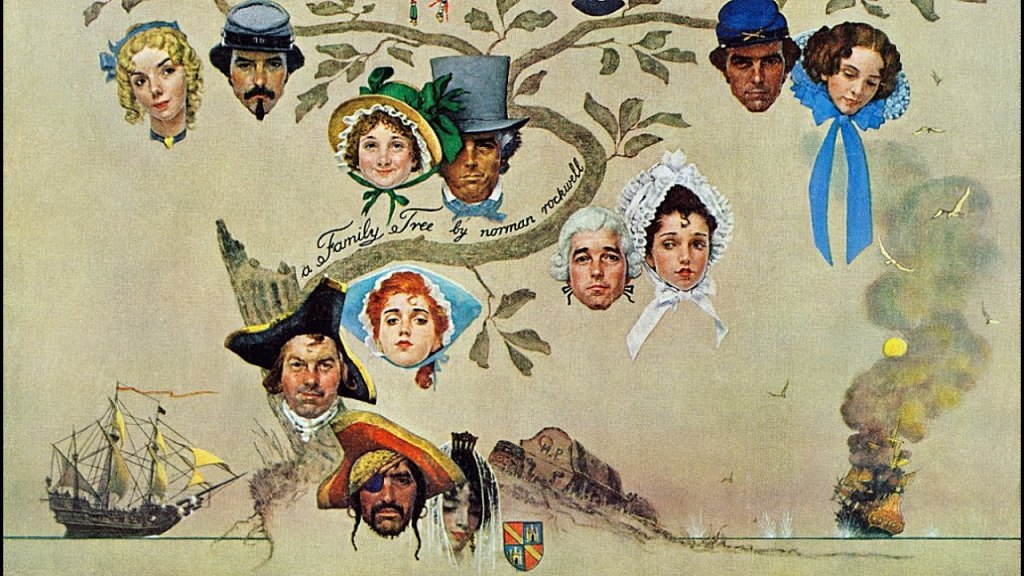
- Description:llustrates a genealogical tree showing the descendants of a pirate, including soldiers and sailors from various American wars.
- Published: The Saturday Evening Post, December 26, 1942
10. War Stories October 13, 1945
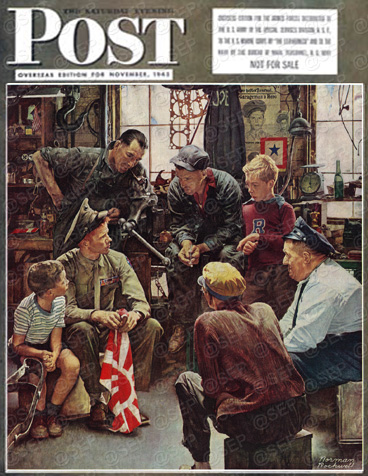
- Description: Shows a young soldier telling stories about the war
- Published: The Saturday Evening Post, November, 1942
There were many more, but these samples are enough to give an idea of the extension of his influence in the American imagination.
Last but not least
The United States’ emergence as a dominant global power following World War II
The United States’ rise to global dominance after World War II brought about significant economic, military, political, cultural, technological, social, and geopolitical changes. These consequences reshaped the global landscape and established the U.S. as a leading power in various domains, influencing international affairs and the world order for decades to come.
1. Economic Consequences
Post-War Economic Boom:
- Economic Growth: The U.S. experienced a period of unprecedented economic prosperity in the post-war years. Industrial production, consumer spending, and technological innovation soared, leading to a higher standard of living.
- Global Economic Leadership: The U.S. dollar became the world’s primary reserve currency, and the U.S. played a central role in establishing global economic institutions like the International Monetary Fund (IMF) and the World Bank.
Sources:
2. Military Consequences
Global Military Presence:
- Military Bases: The U.S. established numerous military bases around the world, solidifying its global presence and ability to project power.
- Nuclear Arsenal: The development and stockpiling of nuclear weapons positioned the U.S. as a superpower in the nuclear age, leading to the arms race during the Cold War.
Sources:
3. Political Consequences
Cold War Leadership:
- Containment of Communism: The U.S. adopted a policy of containment to prevent the spread of communism, leading to various conflicts and interventions, including the Korean War, the Vietnam War, and numerous other Cold War confrontations.
- NATO and Alliances: The formation of NATO and other military alliances strengthened U.S. political and military influence across Europe and other parts of the world.
Sources:
4. Cultural Consequences
Cultural Influence:
- Hollywood and Media: American culture, particularly through Hollywood films, music, and television, spread globally, influencing lifestyles, fashion, and cultural norms.
- Soft Power: The U.S. exerted significant “soft power” through cultural diplomacy, promoting American values of democracy, freedom, and capitalism.
Sources:
5. Technological and Scientific Consequences
Technological Leadership:
- Space Race: The U.S. invested heavily in science and technology, exemplified by the space race and the moon landing in 1969.
- Innovation: Advancements in technology, medicine, and engineering positioned the U.S. as a leader in innovation and research.
Sources:
6. Social Consequences
Civil Rights Movement:
- Racial Equality: The post-war period saw significant advancements in civil rights, culminating in landmark legislation like the Civil Rights Act of 1964 and the Voting Rights Act of 1965.
- Social Change: The war and its aftermath also catalyzed changes in gender roles and expectations, contributing to the feminist movement.
Sources:
7. Geopolitical Consequences
Bipolar World Order:
- U.S.-Soviet Rivalry: The U.S. emerged as one of the two superpowers, leading to a bipolar world order characterized by the Cold War rivalry with the Soviet Union.
- Influence in International Affairs: The U.S. took a leading role in international organizations like the United Nations, shaping global policies and responses to international crises.
Sources:

