This chinese ideogram came to my attention because in a documentary about the japanese film director Ozu Yasugiro it showed that it was inscribed in his tomb.

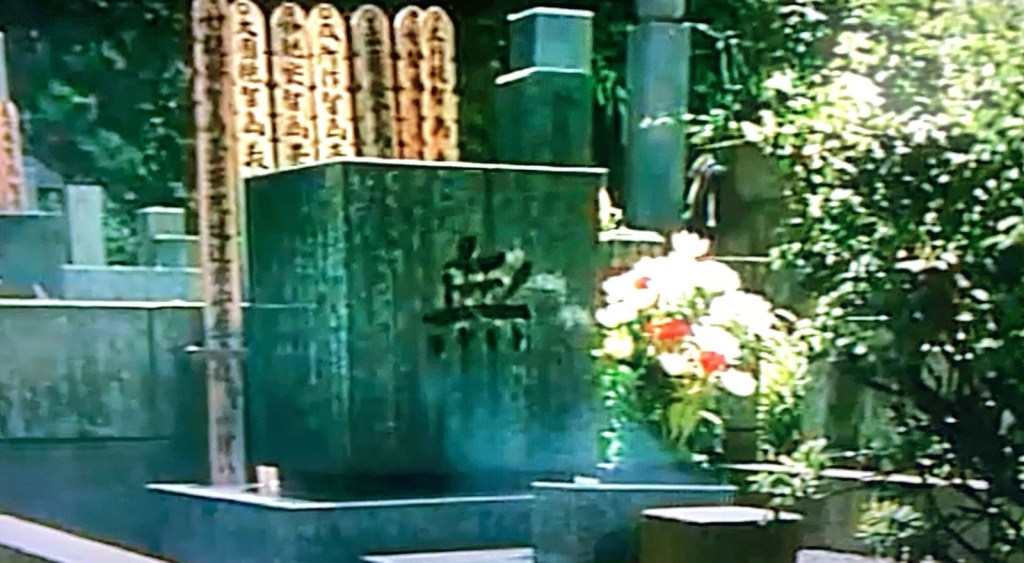
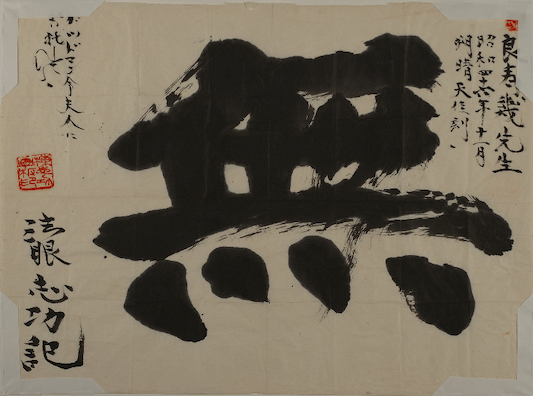
To figure out what is at stake in Mu’s ideogram which is engraved at Ozu Yasugiro‘s grave, let’s take a look at his films. Since it is not practical, let´s rather see Tokyo Story, which is the hallmark of his accomplishments:
His focus is family life in Japan, but his characters in his films are very much universal. In Ozu’s films, particularly this one Tokyo story, you can see yourself and those surrounding you, especially the loved ones. A film made in 1953, yet is eternal and practically anyone, adult, can relate to it and encounter with oneself.
Allthough Ozu made movies since the silent films in the 20’s he also did talkies and modern technology coloured movies up to the 60’s (which can be seen in the list above) until he died in 1963.
He was considered too japanese to interest anyone outside Japan by the japanese distributors and they never cared to export his movies, making him unknown outside Japan until the 80’s. His films could be seen in some specific Japanese cultural centers abroad and Wim Wenders tells us that an american housewife (whose name he didn’t remember) saw some of his movies in a Brooklyn, NY, japanese cultural center and she was so impressed that made a mission of her life to make Ozu’s films available to the american audience. Let’s hear it from Wim Wenders in a class he did in 2019:
In this class, he discussed aspects of filmaking that because of the technological revolution which digitalization brought to the industry, Ozu’s movies became even more important and valuable and he explained why:
Before the advent of digitalization, or the digital revolution, the equipment, cameras, films, laboratory procedures to reveal the film strips, etc. were very expensive and not at the reach of the average person. Today, anybody can make a film and he knows young 18 years old kids who produced 90 minutes movies. This is an opportunity and a danger, because with this inflation came a devaluation that shatters what he calls sacredness of the images which nowadays are produced carelessly and at a speed which are entirely different from the era before digitalization. The cinema, as an entitity changed completely and something which was precious is lost. Everything in a Ozu film has some sort of hollinness in it and is carefully placed there. The effect can be seen for example when Ozu creates the image of a father, or the mother, or a famil, he does it in such a fashion that you are seeing a kind of archetype image, i.e., the father, the mother and the family of them all. This is what makes his movies universal and timeless and above all, you feel it under your skin or with your heart and there is no need for an explanation for you to perceive it.
As he told, he went to Japan in 1983 and filmed a lot of images and related subjects to Ozu and he issued a documentary about Ozu which recently has become available worldwide (2024) and can be seen at Prime video. It is not yet available at Youtube, but you can see the trailer:
To grasp why he is so acclaimed, let´s take a look at the documentary Talking with Ozu (1993), a tribute to Yasujiro Ozu featuring Lindsay Anderson, Claire Denis, Hou Hsiao-hsien, Aki Kaurismäki, Stanley Kwan, Paul Schrader and Wim Wenders:
All these directors give their impressions which can be summarized the following way:
It is like reflections on a mirror. What does Ozu Yasujiro reflect? He reflects reality. But, what actually is reality? Reality is a “work in progress”, i.e., an unfinished project that is still being added to or developed.
Ozu not only grasps this ever changing characteristic but he manages to create a story with images that have the power to bring up life experience as most people live it, or what life is about, specially parents, family and children, which are themes that affect us all.
Another feature is that he does that in a personal way, i.e., these directors and I imagine most viewers, relate their own personal life experiences with those Ozu puts up there on the screen. Perhaps this has to do with his straightforward way to tell the story with a mix of honesty and irony which brings his special kind of humour which is never sarcastic.
Although his films were made a long time ago, there is also an agreement that his films do not become old fashioned or out of date.
It is very important to notice that he managed to discuss all important aspects of life without recurring to murder or violence, which seems to be the hallmark of modern film making, especially in the United States.
His insights on the human condition are perhaps one of the best ever yet attained by cinema.
I discuss reality separately under discursive perspective and it becomes clear the value of Ozu’s approach to reality, which is what reality is as you can feel it and not an endless discussion tied to some kind of reference that cannot reach any conclusion. This is what made him great and so important, because he manages to make you feel as “the real thing” which Wim Wenders so aptly described in his documentary about him and I quote:
“Each person knows for himself what is meant by the perception of reality. Each person sees his reality with his own eyes. When sees the others, above all the people one loves, when sees the objects surrounding oneself, sees the cities and countrysides where each one lives, when also sees death, men’s mortality and transitoriness of all things, when sees and experiences love, loneliness, happiness, sadness, fear, in short, each person sees for himself: life. And each person knows for himself the extreme gap that often exists between personal experience and the depiction of that experience up there on the screen. We have learned to consider the vast distance separating cinema from life as so perfectly natural that we gasp and give a start, when we suddenly discover something true or real in a movie. Be it nothing more than the gesture of a child in the background or a bird flying across the frame or a cloud casting its shadow over the scene for but an instant. It is a rarity in today’s cinema to find such moments of truth. For people or objects to show themselves as they really are. That’s what was so unique in Ozu’s films. and above all in his later ones. There were such moments of truth. No, not just moments, a long range of truths lasting from the first image to the last.Films which actually and continuously dealt with life itself and in which the people, the objects, the cities and the countrysides reveal themselves. Such a depiction of reality, such an art is no longer to be found in cinema. It was once. Mu. nothingness. What remains today.”
Ozu Yasujirō’s Grave Tombstone with the “Mu” Chinese Ideogram
Ozu Yasujirō, one of Japan’s most esteemed filmmakers, is buried at the Engaku-ji Temple in Kamakura, Japan. His grave is marked by a simple tombstone inscribed with the Chinese character “無” (Mu), which translates to “nothingness” or “emptiness.” This choice of inscription reflects profound philosophical and spiritual meanings.
Significance of “Mu”
- Philosophical Context:
- Buddhism: In Zen Buddhism, “Mu” signifies a fundamental concept of emptiness or void. It denotes a state of being that is free from desires, attachments, and illusions, representing the ultimate reality beyond the duality of existence and non-existence.
- Zen Koan: The character “Mu” is famously used in a Zen koan (a paradoxical statement or question used in Zen practice to provoke deep thought and enlightenment). One well-known koan involves a monk asking, “Does a dog have Buddha nature?” to which the Zen master Joshu replies, “Mu,” indicating that the question is beyond conventional logic and dualistic thinking.
- It is what we call loaded question, i.e., the context does not allow an answer what is more easily understood as “wrong question”
- Source: Stanford Encyclopedia of Philosophy – Zen Buddhism, The Zen Koan as a Means of Attaining Enlightenment
- Personal Philosophy:
- Minimalism: The choice of a simple tombstone with a single character aligns with Ozu’s minimalist aesthetic in his films, which often feature restrained visual style and subtle narrative techniques. This minimalism in both his work and his final resting place underscores a focus on the essence of things rather than their external complexities.
- Life and Death: The inscription reflects Ozu’s contemplation on life’s transience and the nature of existence. In his films, he frequently explored themes of impermanence, family dynamics, and the passage of time, all of which resonate with the idea of “Mu” as a state of acceptance and letting go.
- Source: Bordwell, D. (1988). “Ozu and the Poetics of Cinema”, Richie, D. (1974). “Ozu: His Life and Films”
- Cultural and Artistic Impact:
- Symbolism: “Mu” represents a broader cultural and artistic symbolism that has been integral to Japanese aesthetics. The concept of “Wabi-Sabi,” which finds beauty in imperfection and transience, is closely related to the philosophical idea of emptiness and simplicity expressed by “Mu.”
- Reflection of Values: The choice of “Mu” encapsulates values that Ozu cherished, such as humility, simplicity, and a deep connection with the natural flow of life, which are evident in his cinematic portrayals of everyday life and human relationships.
- Source: Japan Times – The Elegance of Japanese Aesthetics, National Geographic – Japanese Culture
Contextual and Cultural Significance
- Grave Location:
- Engaku-ji Temple: Ozu’s grave is located at Engaku-ji, a Zen Buddhist temple in Kamakura, which is known for its serene environment and historical significance in Japanese Zen Buddhism. The location itself complements the philosophical message of “Mu” due to its association with meditative practices and Zen teachings.
- Source: Engaku-ji Temple Official Site
- Legacy:
- Lasting Influence: The simplicity and depth of the tombstone’s message continue to inspire and intrigue filmmakers, scholars, and fans of Ozu’s work. It serves as a powerful reminder of his legacy and the philosophical depth that permeated his films.
- Cultural Reference: The use of “Mu” has become a cultural reference point for understanding Ozu’s approach to life and art, reflecting a worldview that finds meaning in simplicity and the contemplation of existence.
- Source: Criterion Collection – Ozu Yasujiro, British Film Institute – Ozu Yasujiro
Conclusion
Ozu Yasujirō’s choice of the “Mu” character for his tombstone encapsulates a profound philosophical statement that resonates with Zen Buddhist teachings and his personal artistic philosophy. It symbolizes a journey towards understanding the essence of life and reality, free from the distractions of materialism and superficiality. This simple yet profound inscription continues to reflect the depth of Ozu’s legacy in both cinema and philosophical thought.
For more detailed exploration:
- Stanford Encyclopedia of Philosophy – Zen Buddhism
- The Zen Koan as a Means of Attaining Enlightenment
- Criterion Collection – Ozu Yasujiro
Other contexts where the idea behind MU can be found
The concept of “Mu” in Zen Buddhism shares significant similarities with Via Negativa, both of which employ negation to transcend the limitations of human understanding and language. By negating what can be said about the divine or reality, both approaches aim to lead practitioners to a direct, experiential understanding that goes beyond intellectual grasping.
M C Escher
M C Escher impossible drawings are a kind of answer to a question which is more suited to the Mu concept and therefore unanswerable.
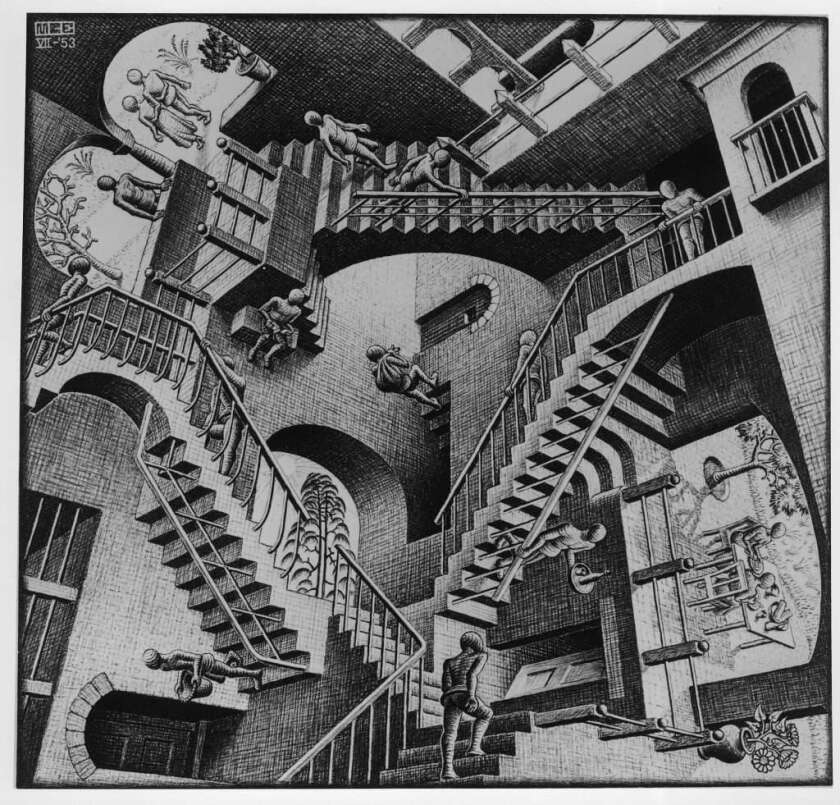
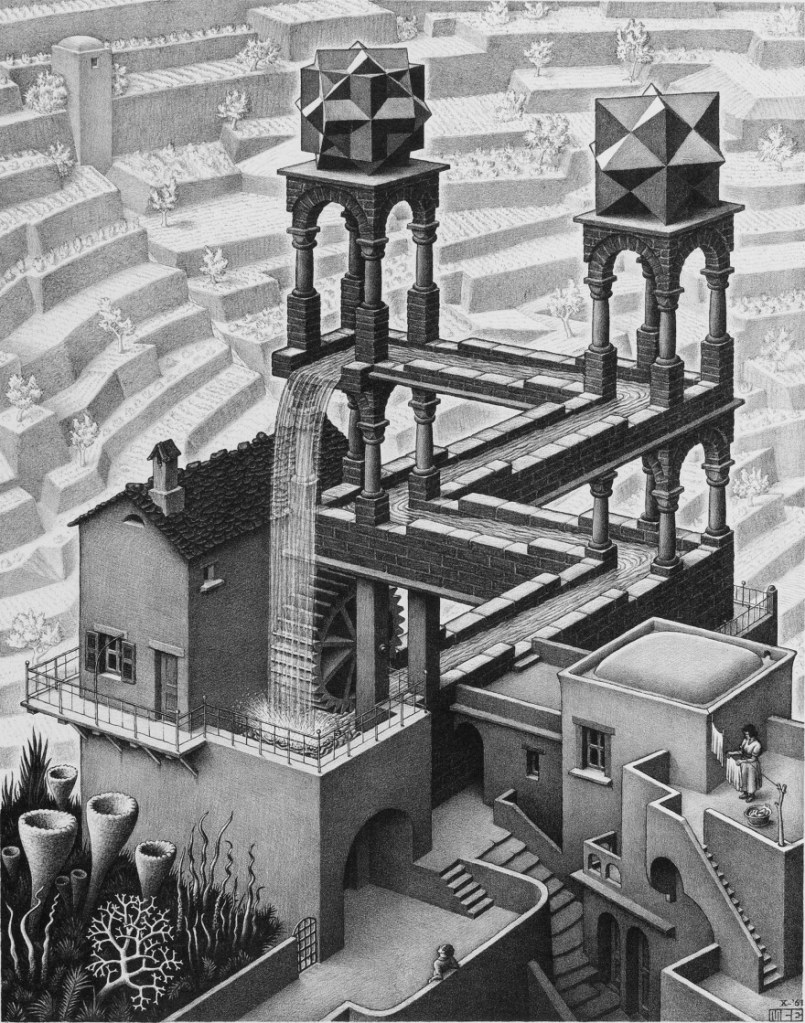
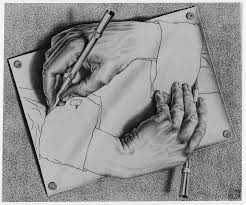
It is insightful to interpret M.C. Escher’s impossible drawings as related to the concept of “Mu” from Zen Buddhism, which represents a question that transcends conventional answers or highlights the limitations of binary thinking.
M.C. Escher’s Impossible Drawings
1. Nature of Escher’s Art:
- Impossible Objects: Escher’s artwork often features paradoxical structures that cannot exist in three-dimensional space, such as the Penrose stairs in “Ascending and Descending” and the endless waterfalls in “Waterfall.”
- Visual Paradoxes: These drawings challenge the viewer’s perception of reality and logical coherence, creating a sense of wonder and confusion.
The Concept of “Mu”
2. Definition of “Mu”:
- Zen Buddhism: In Zen, “Mu” (無) translates to “no,” “not,” or “nothingness.” It is used to indicate the negation of a question that is based on faulty premises or binary logic.
- Unanswerable Questions: The concept of “Mu” suggests that some questions do not have meaningful answers within the conventional framework of thinking and require transcending those limitations to achieve enlightenment.
Example: The famous koan “Does a dog have Buddha-nature?” answered with “Mu” indicates that the question itself is flawed and that true understanding lies beyond the yes/no dichotomy.
Linking Escher and “Mu”
3. Escher’s Art as Visual Koans:
- Transcending Logic: Like Zen koans, Escher’s impossible drawings invite viewers to transcend logical thinking and experience the limits of rationality.
- Mindfulness and Perception: Engaging with Escher’s work can be seen as a form of mindfulness practice, drawing attention to the nature of perception and the constructed nature of reality.
Philosophical and Artistic Implications
4. Challenging Perception:
- Philosophical Inquiry: Both Escher’s art and the concept of “Mu” challenge the viewer to reconsider their understanding of reality and question the assumptions underlying their perceptions.
- Art as Meditation: Viewing Escher’s work can be a meditative process, encouraging a deeper awareness of the mind’s role in constructing reality.
Sources:
Conclusion
Understanding M.C. Escher’s impossible drawings as analogous to the concept of “Mu” in Zen Buddhism provides a profound way to engage with his work. It frames these drawings as not just artistic curiosities but as tools for philosophical and meditative exploration, inviting viewers to experience the limits of logical thinking and the nature of perception.
Gödel’s Incompleteness Theorems
Relationship between the chinese ideogram MU and Gödel’s Incompleteness Theorems which demonstrate how statements within a mathematical system can refer to themselves, creating a loop of truth and unprovability.
The Concept of “Mu”
1. Definition:
- “Mu” (無): In Zen Buddhism, “Mu” is often used to negate the premise of a question, implying that the question itself is flawed or that it transcends binary logic. It encourages thinking beyond conventional dualities and logical constraints.
- Example: The Zen koan “Does a dog have Buddha-nature?” is answered with “Mu,” indicating that the question cannot be answered within the confines of conventional logic.
Sources:
2. Gödel’s Theorems:
- First Theorem: In any consistent formal system that is capable of expressing arithmetic, there are true statements that cannot be proven within the system.
- Second Theorem: No consistent system can prove its own consistency.
- Self-Reference: Gödel’s work showed how statements within a mathematical system could refer to themselves, creating self-referential loops that lead to incompleteness and unprovability.
Sources:
Relationship Between “Mu” and Gödel’s Theorems
3. Transcending Conventional Logic:
- Negation and Self-Reference: Both “Mu” and Gödel’s Theorems deal with the limits of conventional logic and binary thinking. “Mu” negates the premises of questions that cannot be answered within the framework of dualistic logic, while Gödel’s Theorems reveal the limitations within formal mathematical systems.
- Example: Just as “Mu” responds to a question by indicating it transcends binary yes/no answers, Gödel’s Theorems demonstrate that within any sufficiently complex system, there are statements that elude true/false categorization within the system itself.
4. Paradox and Limitations:
- Paradox: Both concepts embrace paradox as a fundamental aspect of understanding reality. “Mu” embraces the paradox of negating a question to reveal deeper truths, while Gödel’s Theorems show that systems of logic are inherently incomplete and cannot fully describe their own structure.
- Limitations of Formal Systems: Gödel’s work aligns with the spirit of “Mu” by showing that some truths lie beyond formal provability, thus inviting a more holistic or transcendent approach to understanding.
5. Philosophical Implications:
- Beyond Formalism: Both concepts encourage moving beyond strict formalism to grasp deeper truths. “Mu” encourages direct, experiential understanding, while Gödel’s Incompleteness Theorems suggest the necessity of meta-mathematical perspectives to understand the limits of formal systems.
Sources:
Conclusion
The Chinese ideogram “Mu” and Gödel’s Incompleteness Theorems both explore the limitations and paradoxes inherent in systems of logic and perception. “Mu” negates questions that are trapped within dualistic thinking, urging a transcendence of conventional logic, while Gödel’s Theorems highlight the inherent incompleteness of formal mathematical systems, suggesting that some truths lie beyond formal proof. Both concepts challenge us to rethink the nature of reality, truth, and understanding beyond the confines of traditional frameworks.
Johann Sebastian Bach’s Compositions
The interplay between Bach’s compositions, particularly his fugues and canons, and the concepts explored by Gödel and Escher can also be linked to the philosophical implications of the Chinese ideogram “Mu” (無). Here’s an elaboration on this relationship:
1. Recursive Structures in Music:
- Fugues and Canons: Bach’s fugues and canons are prime examples of musical recursion and self-reference. In a fugue, a theme or subject is introduced and then developed in multiple, interweaving voices, creating a complex, recursive structure.
- Fugues and Canons are not literally endless, but they exhibit recursive structures and techniques that can create the illusion of infinite continuation.
- Example: In “The Art of Fugue,” Bach explores variations of a single theme in multiple ways, demonstrating how a simple motif can be transformed through recursive patterns.
Sources:
3. Visual Paradoxes and Recursion:
- Impossible Structures: Escher’s drawings, like “Ascending and Descending” or “Relativity,” use visual paradoxes to challenge the viewer’s perception of space and logic, similar to how Bach’s music and Gödel’s theorems challenge auditory and mathematical perception.
- Self-Reference: Escher’s works often include self-referential elements that loop back on themselves, creating endless cycles and paradoxes.
Sources:
The Chinese Ideogram “Mu” (無)
4. Concept of “Mu” in Zen Buddhism:
- Negation and Transcendence: “Mu” negates the premises of questions that are limited by conventional logic, encouraging a transcendence of binary thinking. It signifies an answer that is beyond the dualistic “yes” or “no,” indicating a deeper, often ineffable reality.
- Parallels in Bach’s Music: Just as “Mu” invites one to move beyond conventional answers, Bach’s recursive structures encourage listeners to experience music in a way that transcends straightforward narrative or linear progression. The music loops and interweaves, much like a Zen koan, prompting deeper reflection and insight.
Sources:
Integration of Concepts
5. Integrating Bach, Gödel, Escher, and “Mu”:
- Transcending Limits: All these elements—Bach’s musical structures, Gödel’s mathematical theorems, Escher’s visual paradoxes, and the concept of “Mu”—invite a transcendence of traditional boundaries and encourage an exploration of the infinite and the paradoxical.
- Exploration of the Infinite: Bach’s use of recursion and variation, Gödel’s demonstration of the inherent limitations of formal systems, Escher’s visual loops, and the philosophical negation of “Mu” all reflect a profound engagement with the infinite and the unprovable.
Sources:
Conclusion
The relationships between Bach’s recursive musical compositions, Gödel’s self-referential mathematical theorems, Escher’s visual paradoxes, and the concept of “Mu” in Zen Buddhism highlight a shared exploration of the limits of conventional understanding. Each in its own way challenges the observer or listener to transcend ordinary logic and perception, offering a richer, more complex appreciation of reality that embraces paradox and the infinite. This interweaving of ideas exemplifies how different disciplines can converge to deepen our understanding of the world and our place within it.
 O Sentido da Vida - The Meaning of life