What would be the American Dream?
I am a visual person and I think that no one brought to our imagination what the American Dream was or is, or has become, better than Norman Rockwell.
When he died, I saw a review in Time magazine, which, then, I subscribed, that I think it is wrong, or inacurate, criticizing, diminishing him as alienated, naive and outdated.
The article, published in xxx 1999, was as follows:
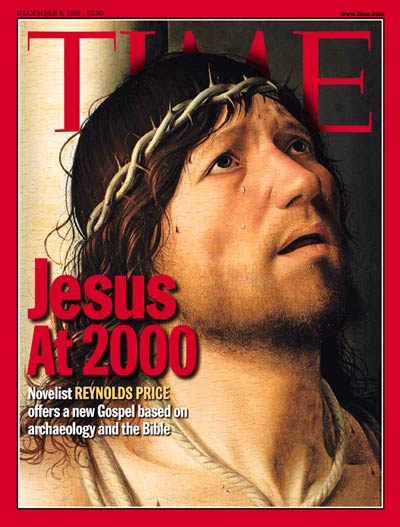
The Innocent Abroad
December 6, 1999 12:00 AM EST
When it comes to Norman Rockwell, we all know what we’re supposed to think. Rockwell is to modern art what Robert Mapplethorpe is to family values–a slap in the face to all serious standards. So much the worse that for decades he was the best-loved American artist, at least until he was usurped by an even shrewder judge of the national disposition, Andy Warhol. To the art world Rockwell was an exasperating holdout, the man who didn’t care that in the 20th century it was simply uncalled for to paint sweet-tempered vignettes in a representational style at something like a molecular level of detail.
So maybe it’s a watershed in cultural attitudes that over the next two years the Rockwell retrospective now at Atlanta’s High Museum of Art will be making a national victory lap. It’s not just that it passes through Chicago, Washington, San Diego and Phoenix, Ariz., then touches down at the Norman Rockwell Museum in Stockbridge, Mass.–the place where his work is usually confined, to contain any risk of aesthetic infection. It’s that the tour ends in triumph at the Guggenheim Museum in New York City, an institution founded as a stronghold of “nonobjective art.” If Rockwell can enter the Guggenheim, look soon for Mapplethorpe at the Vatican.
Maybe it’s not such a surprise. The standard version of modern art history–the story that moves through the Impressionists and Cezanne to Cubism, and from there through ever greater reaches of stylization, psychic turmoil and abstraction–has been under pressure for years to admit developments that can’t be legitimized under that model. The creamy maidens of Victorian genre painting, “outsider art” by the mentally ill, hard-to-categorize painters like Jacob Lawrence and Florine Stettheimer–all of them have been tried out on museum walls. It was only a matter of time before attention turned back to Rockwell, a man who could paint cute but intricate scenes like The Runaway, where a cop and a waiter at a lunch counter size up a wayward but innocent kid. Is this art rising from the primordial muck of kitsch? Or just kitsch? As the grownups look him over, the kid makes you think of Rockwell being examined by the powers that be. Including us.
Among critics and curators, the Rockwell show is now an occasion to announce themselves as Rockwell converts or as closet fans all along. Anytime the higher echelons of the culture industry set out to show how they’re in touch with ordinary folks, they risk sounding like George Will when he writes about baseball. But this exhibit is an indicator of a real impulse in the art world lately to find vitality wherever it’s to be found, now that the energies that moved modernism have long ago run aground. Perhaps for the first time in history, it’s truly possible to ask an essential question: Can you take seriously an artist who illustrated 50 years of the Boy Scout calendar?
The answer, of course, is, How can you not take him seriously? Even when you see every one of his 322 covers for the Saturday Evening Post spread out across one gallery of the show–and notice that more than a few of them really are a little precious–you have to admit to Rockwell’s ingenuity. What the original canvases for those covers make plain is that he was a painter of great if anachronistic gifts. He carried into the 20th century the ancient pleasures of visual storytelling and fine-grained description. These happen to be the same enjoyments that art has largely turned over to photography, movies and television, none of which can offer back the visual world with anything like the mouth-watering delights of paint.
Rockwell could. He knew how a few brushstrokes can mimic wet hair, effulgent sunlight, gunmetal, crinoline, catsup, cardboard, painted brick and polished linoleum. And he got those effects without losing sight of the muddy pleasure of pigment itself, a fundamental notion of modern painting. In a few inches of sailcloth or the slip worn by his Girl at Mirror, he could put white paint through as many adventures as Robert Ryman does in his snow-flurry abstractions. As for his pieties, they turn out sometimes to be the same ones fundamental to civil society. By nothing less than an actual vote among Post readers, Saying Grace was his most popular canvas. In a flyblown city restaurant, a boy and his grandmother bow their heads to pray while everybody else looks on. If the picture is about the secular world making space for the spiritual, which it plainly is, it’s also about the larger notion of every tribe in American society making space for every other.
Too bad Rockwell’s democratic spirit can’t blind you to the fact that so many of his pictures really are the insipid jokes and consoling fictions they were always said to be. The fact that sentimentality in painting has a pedigree reaching back to Rubens doesn’t make Rockwell’s puppy dogs any more digestible now. There are parts of this show that could make you hate Santa Claus.
Until World War II, the larger commotions of the century don’t get into Rockwell’s work at all. Looking at his output from the 1930s, you would never know there was a Depression. When the century exploded, he cushioned the blows. He once said, “This is where I can find America the way I want it.”
As it turned out, in his own politics Rockwell was a liberal, which could be guessed from the understated plea for tolerance that so many of his pictures make. In the 1960s, when he left the Post for Look magazine, he turned to producing plainer public statements like The Problem We All Live With, a bare rectangle in which a black girl is chaperoned by federal Marshals as she tries to integrate a Southern school. Public rhetoric was never Rockwell’s strength. But he brings such a hard-lit, neoclassical calm to this moment that the remnants of a tomato smashed against the wall behind her are more shocking than a pool of blood.
By the time he died, in 1978, Rockwell occupied a place somewhere between Vermeer and Disney, a hard spot to locate, much less evaluate. But whatever else he was, Rockwell was the road not traveled. You go through this show wondering what 20th century art might have been like if it had not been so quick to put aside anecdote, draftsmanship and the raptures of watching paint do its dead-on imitations of other stuff. In short, what it might have been like if it valued more what Rockwell did. Given the essential places where painting had to go, places where Rockwell couldn’t follow, maybe art had to put those things aside. But his best pictures remind you of the powers it gave up as a consequence. It may be true that Rockwell did nothing to advance art history. But what he did, in his humble way, was humble it.
Norman Rockwell’s painting Saying Grace sold for $46 million at a Sotheby’s auction in New York City in 2013, making it the most expensive American painting ever sold at auction. The painting was more than double its pre-sale estimate of $15–20 million.
Andy Warhol’s Shot Sage Blue Marilyn sold for $195 million at Christie’s New York in May 2022, making it the most expensive 20th-century artwork ever sold at auction. The painting is part of Warhol’s Shot Marilyns series, which depicts Marilyn Monroe against a sage blue background.
A million flies can’t be wrong…for me, to categorize works of art in its auction value, brings to mind that…
Here is my reason why I think Norman Rockwell embodies the American Dream and why he, while the quintessence of good and beautiful, was also concerned with evil.
Norman Rockwell
Posted on by Roque E. de Campos
Norman Rockwell was an American painter and illustrator.
His works enjoy wide popular appeal in the United States and for those who appreciate them for their reflection of American culture, at least in terms of how it is idealized by Americans themselves.
He is best known for his illustrations on the covers of The Saturday Evening Post magazine for
40 years.
He created characters or sequences of subjects, which he used for his illustrations. The most famous characters and subjects are: Willis Gillis, Rosie the Riveter, Saying Grace, The Problem We All Live With and the most famous series of all, The Four Freedoms .
Willis Gillis
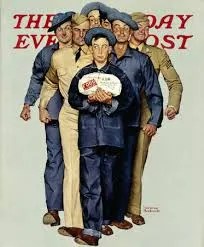
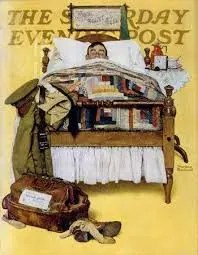
He is a fictional character who represented the typical American soldier of World War II. The images created by Norman Rockwell were dedicated to the human side of war. In Rockwell’s own words, ” Gillis was a harmless, ordinary, simple individual who had been thrown into the chaos of war.” The public identified with Rockwell’s perception of the ordinary, simple, small person, responding within his narrow horizon to the sense of duty in those times of war.
One of the happiest paintings in this series is of a soldier at home helping his mother prepare a Thanksgiving meal, a very strong American institution. Even if this does not exist, there is nothing stronger in human reality than the feeling that the mother’s gaze reveals when looking at her son in this painting. And his tranquility, unarmed in that environment, is one of the most enviable things one could wish for: peace for someone who comes from the life-or-death struggle that is war.

Rosie the Riveter
It is not an icon of its creation. It is an American cultural icon representing the American woman who worked in factories during the Second World War. They had to take on jobs typical of men, who were serving in the military, producing ammunition and war supplies.
Rosie became a symbol of feminism and women’s economic power.
She was born in 1942 from a campaign by the American government to motivate housewives to go to work in factories in jobs that were typically male, such as operating drills, lathes, presses, welding machines, etc. The character became a song that was popularized at the time by several artists. It is said that she was based on Rosie Bonavitas, who worked at the Convair aircraft factory in San Diego. She would have resembled Veronica Foster, the model for the poster published in Canada for the same purpose.
There was a certain coincidence between the first Saturday Evening Post cover painted in this vein, where a stout woman on her lunch break, with a riveting pistol in her lap, stepping with her shoes over a copy of Hitler’s manifesto, Mein Kampf. Her lunchbox reads “Rosie”; and readers quickly identified her with the “Rosie the Riveter” from the song
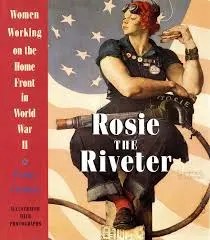
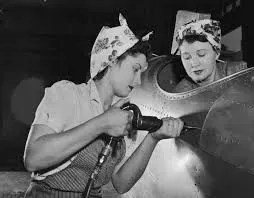
There were many other non-Rockwell images, but he gained more attention because of the circulation of the Saturday Evening Post.
An original painting by Norman Rockwell of Rosie sold in 2002 for $5 million. The model who posed for this painting, Mary Doyle, was paid $10 for it when the painting was painted.
According to the Encyclopedia of American Economic History , Rosie the Riveter inspired a social movement that increased the participation of American women in the male workforce from 12 million to 20 million in 1944, an increase of 57%.
In 1944, only 1,700,000 single men between the ages of 20 and 34 worked in the defense industry, while in the same period, about 4,100,000 women did so. Although the image depicted welding, riveting, and drilling, the majority of women worked in non-factory positions in all sectors of the economy. They demonstrated that they could do “a man’s job” and do it well. The proportion of “acceptable” tasks for women rose from 29 to 85 percent in 1942.
Women were convinced that it was a patriotic duty to enter the workforce.
There are many other angles that do not fit here but that deserve consideration.
Saying Grace

This is perfect for a discussion of Norman Rockwell.
Art critics, painters, and connoisseurs turn their noses up at him and despise him…
This kind of criticism is about the subject matter, not purely aesthetic values. It is clear that Rockwell, whether consciously or not, was a propagandist of small-town American culture. He was clearly constrained in his choice of subject matter by the editors of the Saturday Evening Post. He had a job to do, and he did it well, using a highly developed technique. If we examine Rockwell’s best work, it is clear that he was a master of composition, a subtle colorist, and an excellent draughtsman of the human figure. In addition, he was a keen social observer whose eye for detail was obsessive and almost pathological. Behind his work there is a second, hidden meaning that neutralizes the more obvious messages of patriotism and the goodness of the American people. Rockwell’s people do not know much, they are not sophisticated or cultured, but they want to learn and help their fellow human beings. Norman Rockwell clearly had faith in the goodness of human nature and was, to that extent, an optimist.
In this painting, Thanksgiving, in the foreground, an older woman stands across from two young men, heads bowed in prayer, her grandson (we can assume) perched beside her in the same manner. The crocodile-skin bag, umbrella, and man’s fedora hat together, and the jacket draped over the shoulders of the chair by the window, suggest some sort of departure. Perhaps they have just seen Dad off to war. There is a story here, the young men, smoking, looking on curiously, and we realize that saying grace is no longer practiced by the younger generation. The other spectators seem equally surprised by this public act of piety. In the cluttered, claustrophobic space, the chairs are used to create depth, as is the case at the table where the diner patron nearby is sitting with his silverware on his plate, looking toward the old lady. The realism of Thanksgiving is not only photographic in its depiction of the luggage, the spices on the table, and the leftover food, but the painting as a whole achieves a naturalness of facial and body expression in the subjects as well.
It is obvious that Rockwell was almost completely unaffected by the revolutionary events in painting that occurred during his lifetime. If we compare it to a painter who became famous and is from the same era, such as Edward Hopper (1882 – 1967), we will feel that where Hopper, who also represented American life in a realistic way, albeit with some degree of abstraction, expressed coldness, alienation, separation, and uncertainty, Rockwell showed joy, sociability, and human warmth. Most 20th century artists found the need to distance themselves from society, especially in the abstraction of the imaginary, creating worlds that exist only inside people’s heads. Especially people disturbed by the direction that civilization has taken.
Rockwell did not, he placed himself at the center of average American values, allowing himself only a few humorous digs here and there and at the simplicity of the naivety of the young or the conservatism of the older generation. He was, therefore, much more of an insider to his general public, being excluded from the avant-garde of American artists (or of any other nationality).
We can understand all this well when we realize that The Scream by the Norwegian Edvard Munch was recently sold for 120 million dollars.

The Problem We All Live With
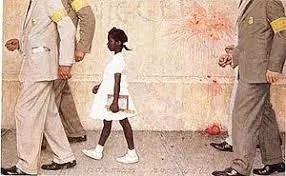
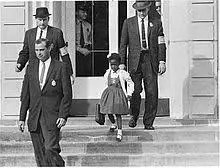
The Problem We All Live With is the name of a 1964 painting by Norman Rockwell. An iconic image of the civil rights movement in the United States, it depicts Ruby Bridges, a six-year-old African-American girl, on her way to an all-white public school in New Orleans on November 14, 1960, during the process of racial desegregation. Because of threats and violence against her, she is escorted by four federal marshals. The painting is framed in such a way that the marshals’ heads are cropped at the shoulders. On the wall behind her is written the racial slur “nigger” and the letters “KKK”, and a crushed tomato thrown at her is also visible. The crowd of white people is not visible, as the viewer is looking at the scene from their point of view.
It was published as a centerfold in Look Magazine , as Rockwell had terminated his contract with the Saturday Evening Post the previous year due to the limitations imposed on his political expression, and Look offered him a forum to do so.
Recently, in July 2011, the girl in the painting suggested to President Barack Obama that he place the painting in the White House, next to the Oval Office, as there is a belief that it should not be displayed in public spaces yet.
This painting is in the Norman Rockwell Museum in Stockbridge, Massachusetts.
I believe that he was inspired by the photo that went around the world of the American soldiers sent by President Dwight D. Eisenhower to force school integration in September 1957 in the city of Little Rock, Arkansas. The soldiers escorted nine African-American students who were being threatened by the threatening mob.
In fact, I consider discrimination in the United States to be a greater paradox than the fatal attraction they feel for war.
Discrimination and war are the feet of the American Peacock…

The Four Freedoms
The Four Freedoms .
President Franklin D. Roosevelt’s “Four Freedoms” speech, delivered on January 6, 1941, was a call to action for the United States and other democracies to work together to defend four essential freedoms throughout the world. These four freedoms were freedom of speech, freedom of worship, freedom from want, and freedom from fear.
President Roosevelt argued that these freedoms were necessary for people to live in peace and security, and that they were under threat from the aggression of fascist powers in Europe and Asia. He called for the United States to take a leading role in defending these freedoms and supporting democracy throughout the world.
No one better than Norman Rockwell to express the image of what these illusions I projected would be like… I thought that in the US everyone lived like they do on his screens, listening to Ray Conniff in fantastic cars, beautiful houses fully equipped with appliances and enjoying a well-being unthinkable for Brazilians born in the 40s and becoming teenagers in the 60s… I unconsciously collected every Ray Conniff LP I saw, here and wherever I was… Recently, a few years ago, as I said before, I donated them all to André Baldinelli, whom I met on the Internet because of Ray Conniff and who has a deep passion for Ray Conniff… In exchange, he digitized everything and gave me the image that is on my computer… Norman Rockwell can be best understood through his paintings, which speak for themselves… I selected four, perhaps the most famous, which are the Four Freedoms:
- Freedom of Speech
- Freedom of Worship Freedom of Belief
- Freedom from Want Economic Security and the Right to a Basic Standard of Living
- Freedom from fear

Which were the materialization in the American imagination of what President Franklin D. Roosevelt proposed on January 6, 1941, which went down in history as the 1941 State of the Union address and which should “include all the people of the world”.
And what was happening to “ all the people in the world ”?
Before we look at that, let’s look at the domestic situation in the US prior to its involvement in World War II.
The State of the Union address The State of the Union Congress was largely about the national security of the United States and the threat from other democracies of World War I that was taking place on every continent in the Eastern Hemisphere. In the address, he broke with the long-standing U.S. tradition of non-interventionism. He emphasized the role of the United States in assisting allies already engaged in the war.
In this context, he summarized the values of democracy that underlay the bipartisan consensus for international engagement that existed at the time. The famous quote from the preface to this address speaks to what these values are: “As men do not live by bread alone, so they do not fight by armaments alone.” In the second half of the address, he lists the benefits of democracy, which include economic opportunity, employment, social security, and the promise of “adequate health care.” The first two freedoms of speech and religion are protected by the First Amendment to the United States Constitution. Roosevelt’s inclusion of the latter two freedoms went beyond the traditional constitutional values protected by the U.S. Bill of Rights. Roosevelt endorsed a broader human right to economic security and anticipated what would become known decades later as the “human security” paradigm in the social sciences and economic development. He also included “freedom from fear” against national aggression before the idea of a United Nations for such protection was conceived or discussed by world leaders and allied nations.
Historical Context of the Four Freedoms Discourse
With the end of World War I (1914–1918), the United States adopted a policy of isolationism and non-interventionism, refusing to approve the Treaty of Versailles (1919) or formally join the League of Nations. Many Americans, remembering the horrors of World War I and believing that their involvement in World War I had been a mistake, were adamantly opposed to continued intervention in European affairs. With the Neutrality Act enacted after 1935, U.S. law prohibited the sale of armaments to countries at war and placed restrictions on travel by belligerent vessels.
When World War II began in 1939 with the German invasion of Poland, the United States was still committed to its non-interventionist ideals. Although Roosevelt, and a large segment of the population, supported the Allied cause, the neutrality laws and a strong isolationist element in Congress ensured that no substantial support could be given. With the revision of the Neutrality Act in 1939, Roosevelt adopted a “methods-short-of-war policy,” under which supplies and armaments could be provided to European allies as long as war was not declared and no troops were sent. By December 1940, Europe was largely at the mercy of Adolf Hitler and the Nazi regime in Germany. With the defeat of France by Germany in June 1940, Britain was left virtually alone against the military alliance of Germany, Italy, and Japan. Winston Churchill, as Prime Minister of Great Britain, asked Roosevelt and the United States to supply them with armaments so that they could continue their war effort.
The Four Freedoms speech delivered on January 6, 1941
Roosevelt’s hope was to provide a rationale for why the United States should abandon the isolationist policies that had emerged from World War I. The speech coincided with the introduction of the Lend -Lease Bill , which promoted Roosevelt’s plan to become the “arsenal of democracy” and support the Allies (primarily the British) with much-needed supplies. In addition, the speech established what would become the ideological basis for the United States’ involvement in World War II, all framed in terms of the individual rights and liberties that are the hallmark of American policy.
Lend-Lease Act
This bill authorized the president to “sell, transfer title to, exchange, lease, loan, or otherwise dispose of, to any government (whose defense the President deems vital to the defense of the United States) any defense article.” In effect, it allowed President Roosevelt to authorize the transfer of military materials to Great Britain with the understanding that they would someday be paid for or returned if they were not destroyed. To administer the program, Roosevelt created the Office of Lend-Lease Administration, under the leadership of former steel industry executive Edward R. Stettinius.
To sell the idea of the program to a skeptical and still somewhat isolationist American public, Roosevelt compared it to lending a hose to a neighbor whose house was on fire. “What do I do in a crisis like this?” the president asked the press. “I don’t say … ‘Neighbor, my garden hose cost me $15, you have to pay me $15 for it’ – I don’t want $15 – I want my garden hose back after the fire is out.” In April, he expanded the program, offering Lend-Lease aid to China in its war against the Japanese. Quickly taking advantage of the program, the British received more than $1 billion in aid by October 1941.
The speech delivered by President Roosevelt incorporated the following
“In the future, the days we seek to make safe today, we look forward to a world founded on four essential human freedoms. The first is freedom of speech and expression – everywhere in the world. The second is the freedom of each person to worship God in his own way – everywhere in the world. The third is freedom from want, which, translated into world terms, means economic arrangements that can guarantee every nation a life of healthy peace for its inhabitants – everywhere in the world. The fourth is freedom from fear, which, translated into world terms, means a worldwide reduction of armaments to such an extent and in such a complete manner that no nation will be in a position to commit an act of physical aggression against any neighbor – anywhere in the world. This is not a vision of a distant millennium. It is a definitive basis for the kind of world that is possible in our own time and generation. This kind of world is the very antithesis of the so-called new order of tyranny that dictators seek to create as if by dropping a bomb. “-Franklin D. Roosevelt, excerpt from the State of the Union Address to Congress, January 6, 1941
The Four Freedoms Flag or “United Nations Honor Flag” ca. 1943-1948

The declaration of the Four Freedoms as a justification for war would resonate throughout the duration of the war and for decades to come, more as a frame of reference. The Four Freedoms became the central unifying force behind the United States’ war aims and the crux of all attempts to rally public support for the war. With the creation of the Office of War Information (1942), as well as Norman Rockwell’s famous paintings, the Four Freedoms were heralded as values central to life and examples of American exceptionalism. This did not occur in the logical sequence that later suggests, as the government rejected Norman Rockwell’s offer, but because the paintings had the effect of making the public understand and gaining popular favor, they were incorporated.
Opposition to the four freedoms
The Four Freedoms speech was a great success, and its goals would be central to the development of postwar human rights policy. However, in 1941 the speech received strong criticism from isolationists and many conservatives in Congress. Critics argued that the Four Freedoms were simply a concession letter to Roosevelt’s New Deal, the social reforms that had already created deep divisions within Congress. Conservatives who opposed social programs and increased government intervention argued against Roosevelt’s attempt to justify and use the war as necessary to defend liberal policies.
While the Freedoms became a force in American thinking about war, they were never the exclusive justification for war. Surveys and polls conducted by the Office of War Information (OWI) revealed that “self-defense” of American values, and revenge for Pearl Harbor, were still the most common reasons for war. Although Roosevelt sought to use the four freedoms as a counter-ideology to fascism and as a force to mobilize an apathetic nation for war in Europe, the record indicates that Americans were more concerned with their own personal experience than with liberal humanitarianism.
United Nations
The concept of the Four Freedoms became part of First Lady Eleanor Roosevelt’s personal mission in influencing the Declaration of Human Rights, United Nations General Assembly Resolution 217A. In fact, these four freedoms were explicitly incorporated into the preamble to the Universal Declaration of Human Rights, which states:
“ Whereas contempt and disregard for human rights have resulted in barbarous acts which have outraged the conscience of mankind, and whereas the advent of a world in which human beings shall enjoy freedom of speech, belief, fear and want has been proclaimed as the highest aspiration of the common man, ….”
Disarmament
FDR called for “a worldwide reduction of armaments,” as a goal for “future days, which we seek to make certain,” but which was “attainable in our own time and generation.” More immediately, however, he called for a massive buildup of U.S. arms production: “Every realistic person knows that the democratic way of life is at this moment under direct attack in every part of the world… The need of the hour is that our actions and our policy should be devoted primarily, almost exclusively, to meeting this external danger… The immediate need is a rapid and direct increase in our production of armaments… I also ask this Congress for authority and for sufficient funds for the manufacture of additional munitions and war supplies of various kinds, to be delivered to those nations which are now at actual war with these aggressor nations… Let us say this to these democracies…” – Franklin D. Roosevelt
The Paintings of Norman Rockwell
President Roosevelt’s Four Freedoms speech inspired a set of four paintings of the same name by Norman Rockwell. The four paintings were published in The Saturday Evening Post on February 20, February 27, March 6, and March 13, 1943. The paintings were accompanied in the magazine by consonant essays on the four freedoms. The most famous essay is on Freedom from Fear.
The United States Department of the Treasury exhibited the Four Freedoms paintings nationwide after their publication in 1943. The exhibition grossed over $130,000 in war bond sales (about $2 billion in 2013 values).
Rockwell’s Four Freedoms paintings were also reproduced on United States postage stamps issued in 1943 and 1946.
The paintings inspired murals, such as the one painted by Michael Lenson in a New Jersey school.
A monument to the first war hero was commissioned by Roosevelt to the sculptor Walter Russell, and the monument was created in 1941 and dedicated in Madison Square Garden in 1943.
Franklin D. Roosevelt Four Freedoms Park was a park designed by architect Louis Kahn for the southern tip of Roosevelt Island. The park commemorates the famous speech and contains the text of the speech, which is inscribed on a granite wall in the park’s final design.
Four Freedoms Medals are awarded at ceremonies in Hyde Park, New York City, and in Middelburg, Netherlands, during alternating years.
Essays on the Four Freedoms and their Representation
The representation that gave rise to the most famous essay and the one that gave rise to the greatest number of criticisms was Freedom of Belief, and it seems that time has not altered the notion that Will Durant printed in his essay that was published in the Saturday Evening Post, together with the illustration by Norman Rockwell.
Freedom of Worship
This article is under copyright, but I got the following excerpts:
Note: This happened when I first published the post, 10 years ago, in 2013, today, in 2023, I found that the article is released, along with others that were commissioned by the Saturday Evening Post and can be read on the Internet.
Why are we religious?
Man differs from the beast in two things: he laughs, and he prays. Perhaps the beast laughs when he plays, and prays when he begs or cries; we shall never know any soul outside our own, and that alone. But the mark of man is that he beats his head against the enigma of life, knows his infinite weakness of body and mind, lifts up his heart to a hidden presence and power, and finds in his faith a cheering beacon of hope, a pillar of strength for his frail decency.
What is the core of religious experience?
Religion, like music, lives in a world beyond words or thoughts or things. These experiences feel the mystery of consciousness within themselves, and will not say that they are machines. These experiences make one aware of the growth of the soil and the child, dwell in awe and reverence in the swelling of the fields, in the hum that pervades the woods, and perceive in every cell and atom the same creative power that springs forth in its own effort and achievement. Their impassive faces hide silent gratitude for the coming of summer, the deadly beauty of autumn, and the joyful resurrection of spring. They have patiently watched the movement of the stars, and found them in a majestic order so harmoniously regular that our ears would endure their music if it were not eternal. Their weary eyes have known the ineffable splendor of earth and sky, even in storm, terror, and destruction, and have never doubted that in this beauty there is some meaning and significance. They have seen death, and looked beyond it with their hope.
Building on this intuition and anticipating a time when many would say they were “spiritual but not religious,” Durant offers the following:
And so they worship. The poetry of their ritual rescues the prose of their daily toil; the prayers they say are secret summonses to themselves to become better; the songs they sing are shouts of joy in their restored strength. The commands they receive, by which they may live with one another in order and peace, are to them as imperatives of an inescapable divinity, not as decrees of questionable men. Through these commands they become part of a divine drama, and their beleaguered lives assume a scope and dignity that cannot be nullified by deaths:
Freedom From Fear
Stephen Vincent Benét
Published in The Saturday Evening Post, March 13, 1943
What do we mean when we say “freedom from fear”? It is not just a formula or a set of words. It is a look in the eyes and a feeling in the heart and a thing to be won against all odds. It goes to the roots of life – a man and a woman and their children and the home they can have and hold.
Fear has stalked the heels of man through many ages – fear of wild beasts and nature, fear of the unexplainable gods of thunder and lightning, fear of his neighbor. He saw his house from the treetops burned with fire from heaven – and he knew not why. He saw his children die of pestilence – and he knew not why. He saw them die of hunger, he saw them become slaves. It happened – and he knew not why. These things have always happened. So he set out to find out – first one thing, then another. Slowly, through the centuries, he fought his battle with fear. And wise men and teachers arose to help him in this battle.
His children and he did not have to die of the plague. His children and he did not have to make human sacrifices to appease the wrath of unexplainable gods. His children and he did not have to kill the stranger just because he was a stranger. His children and he did not have to be slaves. And the form of fear grew less. No man did it for himself. It took many men and women, over many years. It took saints and martyrs and prophets—and ordinary people. It all began with the first fire in the first cave—the fire that scared away the beasts of the night. This fire will not end with the conquest of distant planets.
Since our nation began, men and women have come here only for that freedom—the freedom from the fear that lies at the heart of every unjust law, from every tyrannical exercise of power by one man over another. They came from all backgrounds—men who had seen the face of tyranny, men who wanted breathing space and a chance to be men. And the cranks and the dreamers came too to build Zion and New Harmony and Americanopolis and the states and cities that perished before they existed—the valuable cranks that pushed the world forward an inch. And a lot of these things never happened, but we made a free nation.
“How would you live out there, stranger?”
“We’re going to live on low-quality wheat infested with bugs and in the open air.” If they had the open air, they would have gotten rid of the low-quality wheat and its bugs.
So in our corner of the world, and for most of our people, we got rid of certain fears. We got rid of them, we got used to getting rid of them. It took fighting and desperate fighting with a lot of things that had to be settled. But a hundred and thirty million people lived in peace with each other and had their own government. And because they were free from fear, they were able to live better, almost completely and generally speaking, than any other hundred and thirty million people ever lived. Because fear can make a burdened man go a mile, but it’s only freedom that makes his load light enough to carry a long distance.
And meanwhile the world around us was getting smaller and smaller. If you looked at it on school maps, yes, it looked like the same big big world with a big safe corner for us. But in time invention and mechanical skill have made it smaller and smaller. When the Wright brothers made their first flights at Kitty Hawk, the world shrank. With those first flights the world began to come together and distant nations began to push their neighboring countries aside.
Now, again in our time, we know fear—armed fear, buzzing in the sky. It is a different sound from the war cry and the shot in the lonely glade, and yet it is the same.
The house is silent at night and the children are asleep. But innocence, good will, distance, peaceful intention, will not keep the children safe from the fear that comes from the sky. No man can keep his house safe in a world that has shrunk. No man can secure himself and say, “This is mine. Do not come near.” And yet, if the world is to go on, and if man is to survive and prosper, man’s house must be kept safe.
So what do we mean by “freedom from fear”? We do not mean freedom from responsibility—freedom from struggle and toil, from hardship and danger. We do not mean to create a cotton-wrapped race, too delicate to endure bad weather. In every world of man that we can imagine, fear and the overcoming of fear must play a part. But we have a chance, if we have brains and courage, to destroy the worst fear that afflicts man today—the fear of starving, the fear of being a slave, the fear of being trampled on because he is one kind of man and not another, the fear of unprovoked attack and of terrible death to himself and his children because of the greed and power of evil men and deluded nations.
It will not be easy to destroy these fears. No man can do it alone. No nation can do it alone. It must be done by all men. It is not enough to say, “Here in our country we are strong. Let the rest of the world sink or swim. We can take care of ourselves.” That may have been true once, but it is no longer true. We are not an island in space, but a continent in the world. As long as air is air, a bomb can kill your children and mine. Fear and ignorance a thousand miles away can spread plague in our own city. War between nations on the other side of the globe can endanger everything we love and cherish.
War, famine, disease are no longer local problems or even national problems. They are problems that concern the whole world and every man. This is a hard lesson to learn, and yet for our own survival we must learn it.
One hundred and sixty-odd years ago, we as a nation affirmed that all men were created equal, that all men were entitled to life, liberty, and the pursuit of happiness. These were grand statements, but we have tried to live up to them, and we have not always succeeded, and sometimes we have failed. But our will and desire, as a nation, has been to live up to them.
Now, in concert with other free nations, we can say that the children you see and children like them throughout the world shall grow to adulthood as men and women free from fear. We say that neither their minds nor their bodies shall be cramped or corrupted by tyranny and oppression. We say that they shall have a chance, and a fair chance, to grow and develop and lead the lives they have chosen to lead, not lives mapped out for them by an overbearing master. And we say that freedom for ourselves involves freedom for others – that it is a universal right, and that it was not given in vain by Providence, and that it cannot be maintained by words alone, but by acts and deeds and life.
We who are alive today did not make our institutions free. We have obtained them from men of the past and we must hold them in trust for the future. If we put the easy way and selfishness above them, this trust that has been placed in us will fail and we shall lose everything, not a part or a degree of freedom, but all that has been built by us and all that we hope to build. True peace will not be won by one victory. It can be won only by long determination, firm resolve, and a willingness to share and work with other men, no matter what their race, creed, or condition. And yet we have the choice. We can have freedom from fear. Here is a house, a woman, a man, their children. They are not free from life and the obligations of life. But they can be free from fear. All over the world they can be free from fear. And we know that they are not yet free.
The painting shows children resting safely in their beds, unaware of the dangers of this world, while their parents look on. The mother is tucking them under the blankets while the father has a newspaper describing the horrors of war, but his attention is completely on the children and not on the alarming stories.

Freedom from Fear

Freedom of Speech

Freedom of Worship

Freedom to have economic security and the right to a basic standard of living
Eleven months after this publication, on December 8, 1941, the United States declared war on Japan, one day after the Pearl Harbor attack, which was, in my view, the most significant event of the 20th century. Three days later, on December 11, Germany and Italy declared war on the United States.
The atomic bomb was dropped on Hiroshima on August 6, 1945, and on Nagasaki on August 9.
Japan surrendered unconditionally (it had never lost a war) on September 2 (after announcing this on August 15).
Mussolini was executed on April 28, Hitler committed suicide on the 30th of the same month.
Germany gradually surrendered, through the commanders-in-chief, who negotiated separately with each other.
On May 1 in Italy, on May 2 in Berlin, on May 4 in Northern Germany, Denmark and the Netherlands, and also in Bavaria and Central Europe.
Goring, second in command after Hitler, surrendered on the 6th.
On the same day, the 6th, the fortress city of Breslau, surrounded by the Russians, surrendered to them. On the 6th and 8th, the forces in the Channel Islands surrendered, with Churchill announcing in a radio address at 3:00 p.m. that same day that “ Hostilities will officially cease one minute after midnight today.”
Jodl and Keitel surrendered unconditionally on behalf of all German forces thirty minutes after the fall of the fortress of Breslau, signing the unconditional surrender to the Americans on the morning of May 7th, repeating the same to the Russians on the 8th.
The 8th became V Day for the Americans, but since it was the 9th in Russia, they celebrated the end of the war on this date.
The division of Germany into four parts, governed by the Americans, the Russians, England (UK) and France, was signed on June 5th.
Truman would announce the cessation of hostilities between the US and Germany on December 13, 1946.
The peace treaty between the Allies and the Axis countries was signed on February 10, 1947. The Federal Republic of Germany was founded on May 23, 1949, its first government formed on September 20 of the same year. On November 22, the war allies formally declared the end of the state of war with Germany on November 22, 1949. The full authority of a sovereign state was granted to it on May 5, 1955, with special powers for England, the US and Russia, which would disappear completely on March 15, 1991.
In Japan it was a little different and is worth a word.
They had never lost a war, as I said, and surrendering was shameful and cowardly, since the Samurai code embedded in military culture decidedly rejected the idea of surrender, with the implicit assumption that the defeated were at the mercy of the victorious, and they themselves never showed mercy to their vanquished, being famous for the way they raped, looted and pillaged, even enslaving the people they dominated.
They imagined that they would suffer the same thing, made worse by the fact that they have a culture of committing suicide if things did not go their way, which indicated serious problems for the allies in resolving all this. This was what was behind their refusal to surrender. It is impossible for us to imagine what they felt (or feel) for the emperor, who is the human personification of the Japanese nation, its culture and civilization, and for whom they were willing to die, perhaps in a collective suicide.
In other words, if the emperor ceased to exist, Japan would cease with him.
In a rare moment of common sense, the Americans understood this, or perhaps they had already understood this in another rare moment of madness, perhaps the greatest of all that a human being can have, when they dropped the bombs, and President Truman guaranteed in writing that Japan would not be enslaved, the emperor would continue to reign, under the authority of the Allied commander, General MacArthur. In view of this, they finally surrendered unconditionally and the document that I transcribe below was signed.
A curious thing about this document, and which reveals much about the nature and condition of man, is that the copy in Japan’s possession and that in the United States differ in the following:
The Allied copy was presented on leather with a gold lining and with the seals of both countries printed on the front. The Japanese copy was made on rough canvas with no seals on the front. The Canadian Representative (who was blind in one eye) signed below and not above the line and created a problem that everyone signed on the wrong line than the one intended for them, and the Japanese objected. When the discrepancy was pointed out to General Sutherland, MacArthur’s chief of staff, he crossed out the pre-printed names of the Allied nations and rewrote the titles in their correct relative positions by hand. This change was initially not accepted by the Japanese, but Sutherland then initialed each change (with an abbreviated signature). To this the Japanese representatives had no further objection.
Japan was occupied for the first time in its history and was transformed into a democracy and in some ways followed the model of President Roosevelt’s New Deal.
The occupation ended on September 8, 1951, and officially ended on April 28, 1952, when Japan once again became an independent country, except for the Ryuku Islands.
Japan would be divided as Germany was, and it is not clear historically why this did not happen. Apparently it was Truman who arranged it.
Russia got North Korea and the Kuril Islands.
The US got South Korea, Okinawa, the Amami Islands, the Ogasawara Islands, and Japan’s possessions in Micronesia. China got Taiwan and Penghu.
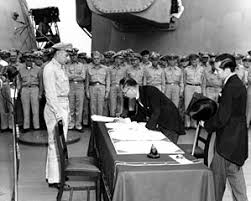
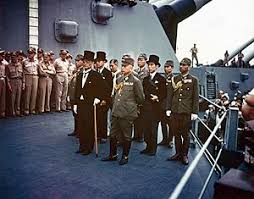
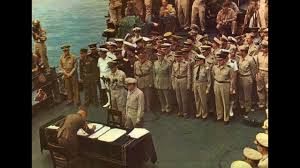
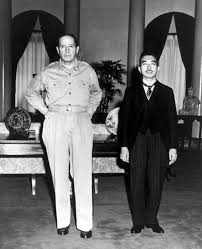
Perhaps the greatest example validating the idea of original sin came from a people who follow a different religious tradition.
I think that perhaps the greatest motivation for dropping the Atomic Bomb on them was not Pearl Harbor, but the kamikazes, demonstrating that they were willing to die rather than lose, another example of original sin.
I visited Pearl Harbor in Hawaii and more than 1,000 young Americans are still down there inside the sunken ships. Interestingly, most of the visitors were Japanese, and at the entrance, when presenting the site, which is an American historical monument, the media does not make any recriminations against the Japanese, in a discourse that is surprising due to its total lack of objectivity and the lack of reference to what is implicit there, as cause and effect.


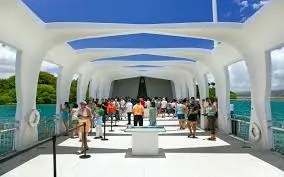

The Japanese surrender document reads as follows:
We, acting by order and in the name of the Emperor of Japan, the Japanese Government and the Japanese Imperial General Headquarters accept the provisions of the declaration issued by the heads of the governments of the United States, China and Great Britain on 26 July 1945 at Potsdam and subsequently confirmed by the Union of Soviet Socialist Republics, whose four powers are hereinafter referred to as the Allied Powers.
We hereby announce the unconditional surrender of the Japanese Imperial General Headquarters to the Allied Powers and of all Japanese Armed Forces and all armed forces under Japanese control wherever situated.
We hereby command all Japanese forces wherever situated and the Japanese people to cease hostilities immediately, to preserve and save from damage all shipping, aircraft and military and civilian property and to comply with all requirements which may be imposed by the Supreme Commander for the Allied Powers or by agencies of the Japanese Government under his direction.
We hereby direct the Imperial Japanese General Headquarters to issue immediate orders to the commanders of all Japanese forces and all forces under Japanese control wherever situated to surrender unconditionally themselves and all forces under their control.
We hereby order all civil, military and naval officials to obey and enforce all proclamations, orders and directives deemed by the Supreme Commander for the Allied Powers to be appropriate for effecting this surrender and issued by him or under his authority, and we order all such officials to remain at their posts and continue to perform their non-combatant duties unless specifically relieved by him or under his authority.
We undertake, on behalf of the Emperor, the Japanese Government, and their successors, to carry out the provisions of the Potsdam Declaration in good faith and to issue whatever necessary orders and measures may be required by the Supreme Commander for the Allied Powers or by any other representative designated by the Allied Powers for the purpose of giving effect to this declaration.
We hereby command the Imperial Japanese Government and Imperial Japanese General Headquarters to immediately release all Allied prisoners of war and civilian internees still under Japanese control and to ensure their protection, care, maintenance and immediate transportation to such places as may be indicated.
The authority of the Emperor and the Japanese Government to govern the State shall be subject to the Supreme Commander for the Allied Powers who will take such measures as he deems appropriate to carry out the terms of surrender.
Signed at Tokyo Bay, Japan, at 09:04 hrs, on the second day of September, 1945
Mamoru Shigemitsu
By Command and on behalf of the Emperor of Japan and the Japanese Government
Yoshijirō Umezu By Command and in behalf of the Japanese Imperial General Headquarters
Accepted at TOKYO BAY, JAPAN at 09.08 on the SECOND day of SEPTEMBER, 1945, for the United States, Republic of China, United Kingdom and the Union of Soviet Socialist Republics, and in the interests of the other United Nations at war with Japan.
Douglas MacArthur
Supreme Commander for the Allied Powers
CW Nimitz
United States Representative
Hsu Yung-Ch’ang
Republic of China Representative
Bruce Fraser
United Kingdom Representative
Kuzma Derevyanko
Union of Soviet Socialist Republics Representative
Thomas Blamey
Commonwealth of Australia Representative
Lawrence Moore Cosgrave
Dominion of Canada Representative
Philippe Leclerc de Hauteclocque
Provisional Government of the French Republic Representative
CEL Helfrich
Kingdom of the Netherlands Representative
Leonard M. Isitt
Dominion of New Zealand Representative
What was behind all this?

And in this context, I was born on April 18, 1943, and this is the backdrop for my analysis.
To complete the picture of the fundamental factors that led the United States to invade the imagination of a Brazilian born where I was born and subject to the environment I was, and to explain a little better why people like me were so attracted to and admired them, we would only have to add the Marshall Plan.
And to understand how all this ended and was reversed, we have to add the Vietnam War.
The American good-naturedness and the reward of having fought perhaps the only war ever considered good, can be summarized in the analysis of the American historian John W. Dover, (John W. Dower: Cultures of War: Pearl Harbor / Hiroshima / 9-11 / Iraq ) specialized in cultures, when he explains the success of the American occupation of Japan and I believe that it can be extended to Germany, Italy and all the countries that were helped by the Marshall Plan or suffered the effects of the American way of managing reality:
“Discipline, moral legitimacy, well-defined and well-articulated objectives, a clear chain of command, tolerance and flexibility in formulating and implementing policies, confidence in the state’s ability to act constructively, the ability to operate abroad free from domestic partisan politics, and the existence of a stable, resilient, sophisticated civil society on the receiving end of occupation policies—these were the political and civic virtues that helped make it possible to move forward decisively during the brief window of a few years when Japan, when defeated, was itself in flux and very receptive to radical change.” [1]
Their “bandit” aspect will be the subject of a more in-depth elaboration in this text, so that we can practice the integration of opposites that is necessary for a dialectical understanding of the USA.
Marshall Plan (Wikipedia)

| Country | 1948-49 (millions of dollars) | 1949-50 (million dollars) | 1950-51 (million dollars) | Total (millions of dollars) |
| Germany | 510 | 438 | 500 | 1448 |
| Austria | 232 | 166 | 70 | 488 |
| Belgium and Luxembourg | 195 | 222 | 360 | 777 |
| Denmark | 103 | 87 | 195 | 385 |
| France | 1,085 | 691 | 520 | 2,296 |
| Greece | 175 | 156 | 45 | 366 |
| Ireland | 88 | 45 | — | 133 |
| Iceland | 6 | 22 | 15 | 43 |
| Italy and Trieste | 594 | 405 | 205 | 1,204 |
| Norway | 82 | 90 | 200 | 372 |
| Netherlands | 471 | 302 | 355 | 1,128 |
| Portugal | – | – | 70 | 70 |
| United Kingdom | 1,316 | 921 | 1,060 | 3,297 |
| Sweden | 39 | 48 | 260 | 347 |
| Switzerland | – | – | 250 | 250 |
| Türkiye | 28 | 59 | 50 | 137 |
| Totals | 4924 | 3652 | 4155 | 12731 [1] |

If it were carried out between 2003 and 2007 it would cost around 740 billion dollars –Niall Ferguson British historian and professor at Harvard, elected one of the 100 most influential people by Time in 2004
As the European Recovery Program , it was the main United States plan for the reconstruction of the countries of Europe in the years following World War II. The initiative was named after United States Secretary of State George Marshall.
The reconstruction plan was developed at a meeting of participating European states in July 1947. The Soviet Union and Eastern European countries were invited, but Joseph Stalin viewed the plan as a threat and did not allow any country under Soviet control to participate. The plan remained in operation for four fiscal years beginning in July 1947. During this period, some $13 billion in technical and economic assistance—equivalent to about $532 billion in 2006 dollars, adjusted for inflation—was provided to help the recovery of the European countries that had joined the Organization for Economic Co-operation and Development (OECD).
By the time the plan was completed, the economy of every participating country, with the exception of Germany, had grown considerably above pre-war levels. For the next two decades, Western Europe would enjoy prosperity and growth. The Marshall Plan is also seen as one of the first elements of European integration, as it eliminated trade barriers and created institutions to coordinate the economy on a continental scale. One intended consequence was the systematic adoption of American administrative techniques.
In recent years, historians have questioned both the true motives and the overall effects of the Marshall Plan. Some historians believe that the benefits of the plan were actually the result of laissez faire policies that allowed markets to be stabilized through economic growth. In addition, some criticize the plan for establishing a trend in the United States to help struggling foreign economies with the help of American taxpayers.
With the devastation caused by the war, Europe faced increasing protests against its established governments. The United States analyzed the European crisis and concluded that it threatened the future of capitalism, which could harm its own economy and pave the way for the spread of communism.
As a result, the Americans decided to help European countries recover. With this goal in mind, they created the Marshall Plan. Initially, the funds were used to buy food, fertilizers, and feed. Soon after, they began purchasing raw materials, semi-finished products, fuel, vehicles, and machinery. Approximately 70% of these goods were of American origin. In addition to benefiting from the Marshall Plan, France created its own economic recovery plan, the Monnet Plan, which was already the seed of the European Community, as it unified the production and distribution of coal and steel.
England also recovered, but lost its economic and political importance. Germany and Italy also began to recover. With the creation of NATO, the United States aimed to guarantee the export of surpluses and establish economic hegemony over the old continent.
Comment (Roque)
After the Vietnam War and especially during the Iraq War, American intellectuals emerged who wanted to undermine the Marshall Plan, saying that it was nothing more than a myth, in order to attack the Republicans, who apparently are the ones who like to put the country at war.
I am well aware of the quality aspect of whatever we do, (I did a Master’s on the subject) which in modern times originated with W.E.Deming’s trip to Japan to help reorganize the country, applying statistical and other techniques to deal with the chaos that reigned there. Later, the Japanese incorporated these techniques into the production of consumer goods that made them rich and famous, perhaps unbeatable in everything they produce, especially automobiles and electronics.
There is no doubt about American help in this regard, and the Japanese National Quality Award is named after the American W.E.Deming.
I think that one of the most harmful effects of the Vietnam War was the loss of innocence and the emptying of the naive virtue that Americans had until then, after having been the good guys who defeated Hitler.
I will assume that the Marshall Plan was true, and that the image I had of Americans when I was growing up was true and largely a product of its effects. I believe that an entire generation of Brazilians (and young people from other countries), like myself, grew up and lived convinced of this, until the Vietnam War.
In an attempt to conclude this perhaps excessively verbose and certainly confusing introduction, I am certain that everything, absolutely everything, that makes up the reality and day-to-day life of practically the entire Western world, especially the Americas and Europe, which for us Brazilians are our universe of reference, is linked in some way to the Second World War and the United States.
And it makes you think that computers, satellites, communications, the Internet, globalization, atomic energy, rockets, and the atomic bomb were all tremendously driven by Hitler’s madness and that all of this practically originated there. And when it wasn’t, as is the case with the computer that was “invented” by John Von Neumann in the US, it was influenced by the pressure generated by the need to confront them, as is also the case with radar.
An excellent topic, exploring Nazi projects and what makes modernity…
I have two stories in which all this mixes and produces the dialectical integration that I want.
Good morning Vietnam
Unfortunately there is no Wikipedia entry for the film, just a synopsis.
Interestingly enough, the film opens with Ray Conniff’s Smoke Gets in Your Eyes , which is the quintessence of the “anesthetic” music that was being imposed, in the film’s plot, by the high command of the armed forces. In the film, Ray Conniff is solemnly despised, along with Percy Faith, Lawrence Welk, Frank Sinatra, etc. The music that Robin Williams’ character wants to replace reflects the revolt against the status quo and the total change of values that was taking place. The “silent majority”, who were Nixon’s voters and today are Trump’s, was represented by Ray Conniff’s music, which was despised for idealizing a world like Norman Rockwell painted…
It is difficult to verbalize or write about, such is the amount of counterpoints it brilliantly presents.
It requires a little knowledge of American history and culture, and preferably English, to fully appreciate it.
I would not be able, that is, I cannot, describe what one feels when watching this film and thinking, or rather, feeling, what is at stake there.
Trying to do this, and simplifying in order to do so, what happens is the following:
The Americans, deep down, in 1939, when the world went into turmoil, did not want to get involved and, in fact, were the characters in Norman Rockwell’s paintings. Country folk, simple, simple-minded, content to think that the meaning of life is movement, inside a Ford or a Chevrolet, going from nowhere to nowhere, unconsciously living in a world where everything comes down to a certain automatism that turns into a capitalist machine that produces, sells, discards, and produces, sells and discards, in an endless cycle, things that most of the time solve problems that do not exist, or have already been solved, making money, like rivers, flow into the sea.
This sea where the 500 largest companies listed in Fortune Magazine swim.
Although George Orwell had already anticipated it in general, somewhat somber terms, in his book 1984 and the thing was more like Jim Carey’s Truman Show , they have always lived in a fishbowl. A golden one, but a fishbowl.
Which is the world that Reader’s Digest creates through the filter that characterizes the type of articles and stories that appear in it. And also the world that Norman Rockwell describes pictorially and Ray Conniff provides the background music…
I don’t know what the meaning of life is, or why we are here. But from any perspective or way of thinking, the basic tone of the experience of being alive is suffering. Which is the only way to grow, evolve, perceive, acquire consciousness.
In the world of Reader’s Digest or in Ray Conniff’s music, there is no space or expectation for this, quite the opposite, or rather, it doesn’t exist there…
I believe that there are periods in people’s lives when they are completely protected from reality and isolated from contact with the “greater evil” that is rampant in the human experience.
The most obvious example is when they are in their mother’s womb, isolated, protected, fed, carried… sleeping… But there always comes a time when birth happens, the light is given, the fight for survival begins, each one tries to establish the meaningful order that characterizes it, in short, it is being alive…
Of course, Americans have always suffered… To avoid going too far, it is enough to mention the recession, the Civil War, the stock market crash, and everything that allowed them to reach a point that is wonderfully well reflected in the article on fear, which was published in the Saturday Evening Post and which I transcribed.
As one can easily conclude, after overcoming the recession, the burden of their cross became plastic…
Entering the war was completely untimely, like life, without a draft, having to learn by doing, when they woke up to the event of Pearl Harbor.
I have already described the sequence and all that remains is to mention a factor that was perhaps the strongest, which allowed Americans to practically remain protected inside an imaginary womb, which was the model created by John Maynard Keynes right after the end of the war.
Keynes was, in my opinion, the greatest economist of all time and his work is too broad and technically boring for the purposes I intend here.
A summary can be found above on Wikipedia.
Although he played an influential and important role in the First World War, or even before it, it was at the end of the Second World War that he established the significant order that governs the world to this day and that gives the United States the privileged position it occupies.
What we can generically call the Bretton Woods System.
When the victory of the Allies began to seem certain, Keynes was deeply involved, as leader of the delegation and chairman of the British World Bank commission, in the negotiations held in the mid-1940s that established the Bretton Woods system. Keynes’ plan, which referred to an international clearing system, advocated a radical system for currency management. He proposed the creation of a common unit of currency, the bancor, and new global institutions – a world central bank and an International Clearing Union. Keynes envisioned these institutions managing an international trade and payments system with strong incentives for countries to avoid significant trade deficits or surpluses. With its greater negotiating power, the US, however, argued that the final results should be closer to Harry Dexter White’s conservative plans. According to American economist Brad Delong, on almost every point where he was rejected by the Americans, it was later proven that Keynes was correct in the course of events.
The two new institutions, later known as the World Bank and the International Monetary Fund (IMF), were founded as a compromise that largely reflected the American vision. There would be no incentive for states to avoid large trade surpluses; instead, the burden of correcting a trade imbalance would continue to fall solely on the deficit countries, which Keynes argued were the least capable of resolving the problem without causing economic hardship on their populations. Nevertheless, Keynes was still pleased to accept the final agreement, saying that if the institutions remained true to their founding principles, “the brotherhood of man will have become more than a figure of speech.”
But everything is regulated by the dollar… which is American money…
Made worse by the fact that what the world produces, especially the good, the excellent, the luxurious or the high quality, is to be sold in the USA…
Which if they suddenly stopped buying, would bankrupt the world…
Where is this in the movie Good Morning Vietnam?
Although in truth the movie opens with the soundtrack of the movie “Around The World in 80 Days” , with Lawrence Welk, with his “champagne music”, who had a TV show that was one of the greatest escapisms that ever happened on American TV, I believe that “ Smoke Gets in Your Eyes ” with Ray Conniff is more perfect to communicate the drowsiness and the state of deception that Americans were living in the face of the barbarity they had gotten themselves into…
Although the best-selling version of this song was by the Platters, in 1958, when it reached number one on the Billboard and similar positions on the American R&B Charts and in English-speaking countries (UK), it had a long list of other interpreters.
For Ray Conniff, it was one of the songs that characterized him and would be remembered forever, as it was on his third album, in 1958, and that propelled him to the level he enjoyed.
Although the context of the story for the song is different, when transposed to what Americans were experiencing, it becomes a perfect metaphor:
Smoke Gets in Your Eyes (from the movie Roberta) Smoke Gets in Your Eyes
They asked me how I knew
My true love was true
Oh, I, of course, replied I naturally replied:
Something here inside
Cannot be denied
They said someday you’ll find
All who love are blind
Oh, when your heart’s on fire
You must realize You must understand [that]
Smoke gets in your eyes Smoke gets in your eyes…”
So I chaffed them, and I gaily laughed,
To think they could doubt our love.
Yet today, my love has flown away,
I am without my love
Now laughing friends deride Tears
I cannot hide
So I smile and say:
“when a lovely flame dies “
Smoke gets in your eyes Smoke gets in your eyes…”
Perfect!…
The irreverence of Adrian Cronauer (Robin Williams)
It represents the new generation’s awareness of the Establishment, represented by their superiors and those in charge of the radio station.
One of them, Lt. Steven Hauk (Bruno Kirby), a mediocre, envious, even well-intentioned “corporate guy”, which I don’t know how to translate, and who believes he is capable of analyzing Cronauer’s (Robin Williams) humor, which would allow him to be on par with him, and which is a wonderful metaphor for the difference between those who teach and those who do, those who analyze and those who are analyzed, in a sudden “smartness”, says:
“I’m also a humorist. Two of my jokes are about to be published in Reader’s Digest… Perfect…
The central plot, about Robin Williams’ involvement with a Vietnamese woman and what happens, is a true parable whose homily was the lesson that Americans needed to learn to stop being simple-minded (idiots would be more correct…) and thinking that the world is populated by idiots who can’t think and everything that this implies, which is not needing to be paternalized, having their own sense of dignity, having their own values and their own culture and… best of all… fighting and imposing this even if it’s with their feet on the ground and with a bow and arrow… and, mockery of mockery, irony of ironies, making the Americans lose the first and only war they’ve ever fought…
If it seems like a contradiction to what I said that I owe most of what I have to the US, and that the four freedoms existed for me, I want to remind you that this is dialectical, that is, we have to examine opposites, which is what I tried to do.
I rest my case asking: “How something like this could not have happened without a lot of evil which I will not care to examine, starting with Pearl Harbor and finishing wish Hiroshima and Nagasaki?”